Tuesday, January 7, 2025

AI For Quantum Error Correction: A Comprehensive Guide To Using Artificial Intelligence To Improve Quantum Error Correction


Insider Brief

Traditional quantum error correction (QEC) methods are limited by high resource demands and inefficiency in handling complex error patterns, but researchers suggest that AI tools like machine learning (ML) could improve QEC.
A study highlights AI’s potential to enhance QEC through advanced ML techniques, including convolutional neural networks (CNNs) for decoding, reinforcement learning (RL) for real-time adaptability, and generative models for capturing complex noise dynamics.
While AI offers promising solutions for quantum error correction, the study underscores challenges such as data scarcity, scalability, and integration with quantum hardware, emphasizing the need for interdisciplinary collaboration to realize AI’s full potential in advancing quantum computing.

Most discussion on artificial intelligence (AI) and quantum are focused on using quantum computing to boost AI. However, the conversation should go both ways because AI can also assist quantum computing.

In fact, AI tools like machine learning (ML) can be used to improve the efficiency and scalability of quantum error correction (QEC), a critical component for making quantum computers more practical. That’s the conclusion of a recent preprint study uploaded to arXiv by researchers Zihao Wang of the University of Pennsylvania and Hao Tang of Peking University.

Quantum computing has potential to revolutionize computational capabilities, by harnessing the principles of quantum mechanics to address problems conventionally intractable for classical computers [2], [3]. Its applications span various domains, including cryptography, optimization and simulation of physical quantum systems,” The team writes. “However, practical implementation of quantum computing faces significant challenges, primarily due to the vulnerability of quantum systems to errors caused by decoherence and quantum noise.”

The team offered a comprehensive review of the opportunity to use AI tools to improve quantum error correction and — by extension — quantum computing, itself.

THE CHALLENGE OF ERRORS IN QUANTUM SYSTEMS

Quantum computing, which promises unprecedented computational power, faces a key challenge: the susceptibility of quantum systems to errors. These errors stem from phenomena such as decoherence, noise, and gate imperfections. Without correction mechanisms, quantum computations quickly become unreliable.

The team writes that traditional QEC methods, such as Shor’s code and surface codes, encode logical qubits across multiple physical qubits to detect and correct errors. However, these methods face significant limitations, including high resource requirements, complex decoding processes, and limited adaptability to real-world quantum noise. For example, surface codes, widely regarded as a scalable QEC solution, often demand thousands of physical qubits to encode a single logical qubit.
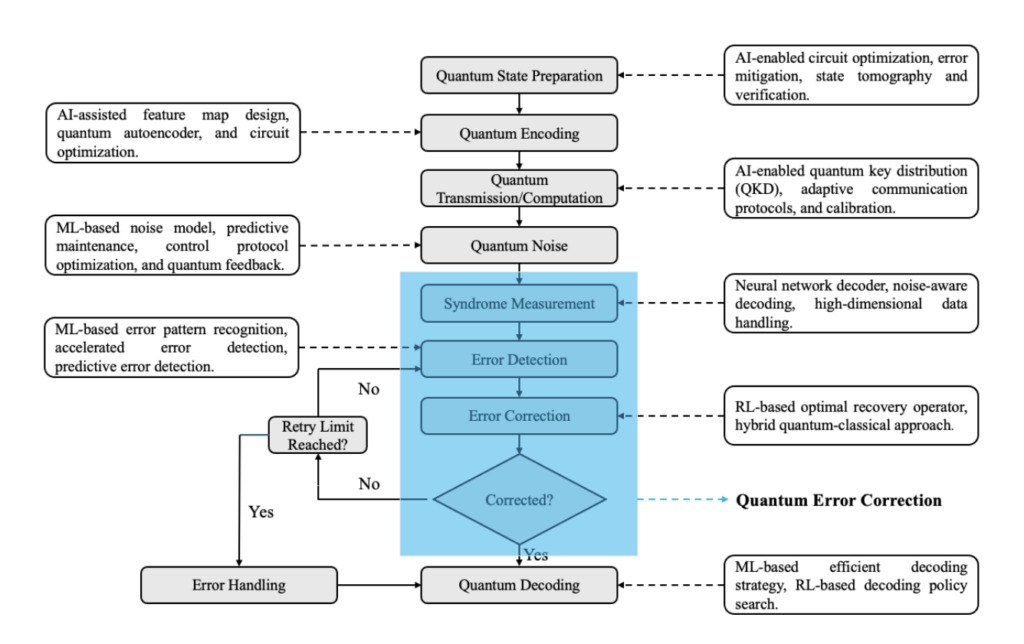


AI’S ROLE IN ADDRESSING QEC LIMITATIONS

The study examines how AI tools can address these limitations by leveraging ML algorithms to decode errors more efficiently, adapt to dynamic environments, and model complex noise patterns. Specifically, supervised learning, unsupervised learning, semi-supervised learning and reinforcement learning paradigms are highlighted as pivotal for advancing QEC.

Some of the ways AI can help is by improving decoding efficiency, enhancing robustness and adaptability, and facilitating complex error modeling:

1. IMPROVING DECODING EFFICIENCY

Conventional decoding algorithms, such as minimum-weight perfect matching, are computationally intensive and scale poorly as quantum systems grow. According to the study, AI models such as convolutional neural networks (CNNs) can drastically reduce decoding times by recognizing error patterns in lattice-based codes like surface codes. These ML models, trained on simulated datasets, demonstrate the ability to identify and correct errors faster than traditional methods while requiring fewer computational resources.

2. ENHANCING ROBUSTNESS AND ADAPTABILITY

Quantum systems are inherently dynamic, with error rates and types fluctuating due to environmental changes and hardware imperfections. Reinforcement learning (RL) techniques, which allow models to adapt to real-time feedback, have shown promise in tailoring error correction strategies to specific system conditions. For example, RL-based decoders can adjust to varying noise levels and detect error correlations that conventional methods might miss.

Moreover, supervised ML models like recurrent neural networks (RNNs) excel in handling time-dependent error patterns, such as non-Markovian noise, which cannot be addressed by static error models. These adaptive capabilities are critical for real-world applications of QEC, particularly in noisy intermediate-scale quantum (NISQ) devices.

3. FACILITATING COMPLEX ERROR MODELING

Modeling quantum errors—especially non-Pauli errors and non-Markovian noise—is another area where AI excels. The researchers highlight the use of generative models like variational autoencoders (VAEs) and RNNs to capture complex error dynamics. These models not only improve the accuracy of error prediction but also enable proactive maintenance by identifying trends that signal system degradation. This predictive capability is vital for stabilizing quantum computations over time.

CASE STUDIES AND APPLICATIONS

The study references multiple recent efforts to integrate AI into QEC workflows. For instance, Google Quantum AI demonstrated the use of neural networks for decoding surface codes, achieving faster and more accurate error correction than traditional algorithms. Similarly, IBM’s research applied ML techniques to identify and mitigate unique error patterns in their superconducting quantum processors.

Another example is the AlphaQubit model, a recurrent neural network designed to decode surface codes under realistic noise conditions. The study notes that such AI-enabled approaches consistently outperform traditional decoders in terms of both speed and error correction fidelity.

CHALLENGES AND FUTURE DIRECTIONS

While AI holds promise for advancing QEC, the study identifies several hurdles that need to be addressed:Data Scarcity: Quantum error datasets are often limited, hindering the training of ML models. Techniques such as data augmentation and synthetic dataset generation are proposed as potential solutions.
Scalability: ML models must be optimized to handle the increasing number of qubits in next-generation quantum systems without excessive computational overhead.
Integration with Quantum Hardware: Seamless integration of AI-driven QEC into existing quantum computing platforms remains a challenge, requiring further research into hardware-software co-design.


Website: International Research Awards on Computer Vision #computervision #deeplearning #machinelearning #artificialintelligence #neuralnetworks,  #imageprocessing #objectdetection #imagerecognition #faceRecognition #augmentedreality #robotics #techtrends #3Dvision #professor #doctor #institute #sciencefather #researchawards #machinevision #visiontechnology #smartvision #patternrecognition #imageanalysis #semanticsegmentation #visualcomputing #datascience #techinnovation #university #lecture #biomedical

Visit Our Website : computer.scifat.com Nomination Link : computer-vision-conferences.scifat.com/award-nomination Registration Link : computer-vision-conferences.scifat.com/award-registration Member Link : computer-vision-conferences.scifat.com/conference-membership/? ecategory=Membership&rcategory=Member
Contact us : computer@scifat.com

Monday, January 6, 2025

How Artificial Intelligence Will Affect Asia’s Economies


Asia-Pacific’s economies are likely to experience labor market shifts because of artificial intelligence, with advanced economies being affected more. About half of all jobs in the region’s advanced economies are exposed to AI, compared to only about a quarter in emerging market and developing economies.

However, as we show in our latest Asia-Pacific Regional Economic Outlook, there are also more jobs in the region’s advanced economies that can be complemented by AI, meaning that the technology will likely enhance productivity rather than replace these roles altogether.

The concentration of such jobs in Asia’s advanced economies could worsen inequality between countries over time. While about 40 percent of jobs in Singapore are rated as highly complementary to AI, the share is just 3 percent in Laos.

AI could also increase inequality within countries. Most workers at risk of displacement in the Asia-Pacific region work in service, sales, and clerical support roles. Meanwhile, workers who are more likely to benefit from AI typically work in managerial, professional, and technician roles that already tend to be among the better paid professions.


As the Chart of the Week shows, we also find that women are more likely to be at risk of disruption from AI because they are more often in service, sales, and clerical roles. Men, by contrast, are more represented in occupations that are unlikely to be impacted by AI at this stage, like farm workers, machine operators, and low-skill elementary workers.


Website: International Research Awards on Computer Vision #computervision #deeplearning #machinelearning #artificialintelligence #neuralnetworks,  #imageprocessing #objectdetection #imagerecognition #faceRecognition #augmentedreality #robotics #techtrends #3Dvision #professor #doctor #institute #sciencefather #researchawards #machinevision #visiontechnology #smartvision #patternrecognition #imageanalysis #semanticsegmentation #visualcomputing #datascience #techinnovation #university #lecture #biomedical

Visit Our Website : computer.scifat.com Nomination Link : computer-vision-conferences.scifat.com/award-nomination Registration Link : computer-vision-conferences.scifat.com/award-registration Member Link : computer-vision-conferences.scifat.com/conference-membership/? ecategory=Membership&rcategory=Member
Contact us : computer@scifat.com

Friday, January 3, 2025

Artificial Intelligence in Biology: From Neural Networks to AlphaFold


With the 2018 release of AlphaFold, an AI deep learning model, scientists were finally able to predict the 3D structure of proteins—a decades-old challenge in biology. Trained on 100,000 known protein sequences and structures, the model can not only accurately predict protein structures with near experimental level accuracy but can also be used to design de novo proteins for a variety of applications in therapeutics and beyond. Inspired by the success of AlphaFold, scientists are now using deep learning models to create spatiotemporal maps of cells, analyze images of cells to detect changes in morphology that indicate disease, and estimate the efficacy of new drugs in halting disease progression to minimize losses in the drug discovery pipeline. Experts like Maddison Masaeli, an engineer scientist and chief executive officer at Deepcell, are happy about the rapid adoption of AI in biology but caution that researchers need significant expertise to harness AI for biological applications.

De Novo Proteins Tackle 21st Century Problems


Harnessing the power of AI models, scientists are now able to design bespoke proteins with specific biological functions, allowing them to solve problems that cannot be addressed by the proteins found in nature. Traditional protein engineering is based on making incremental changes and observing their effects, but machine learning models can both design better proteins and significantly speed up the process. Protein design specialist David Baker and his team at the University of Washington used several different AI models to design stable luciferase enzymes that can bind to synthetic luciferin to glow, with applications in the deep imaging of animal tissue. While this type of protein design has room for improvement and isn’t yet fully automated, it could be used in the future to create a variety of proteins for therapeutic and other purposes.


AI Discovers New Antibiotic for Drug-Resistant Bacteria

The design of de novo proteins using AI could be a major boon in antibiotic development. With the incidence of antimicrobial resistance increasing worldwide and a dearth of new antibiotics being discovered, researchers at McMaster University have turned to AI to design novel antibiotics that can be easily synthesized. Led by biochemist Jon Stokes, the team developed a generative AI model called SyntheMol to design small molecules that possess antibacterial activity against Acinetobacter baumannii, a drug-resistant pathogen considered by the World Health Organization as a major threat to global health. Although they haven’t been tested in human subjects yet, several of the molecules inhibited the growth of the target bacteria as well as other drug-resistant microbes in vitro.

 
Artificial Neural Networks Learn Like Human Brains

Previously met with skepticism, AI won scientists a Nobel Prize for Chemistry in 2024 after they used it to solve the protein folding and design problem, and it has now been adopted by biologists across the globe. AI models like artificial neural networks and language models help scientists solve a variety of problems, from predicting the 3D structure of proteins to designing novel antibiotics from scratch. Researchers press on with the refinement of AI models, addressing their limitations and demonstrating widespread applications in biology.


AI Discovers New Antibiotic for Drug-Resistant Bacteria

The design of de novo proteins using AI could be a major boon in antibiotic development. With the incidence of antimicrobial resistance increasing worldwide and a dearth of new antibiotics being discovered, researchers at McMaster University have turned to AI to design novel antibiotics that can be easily synthesized. Led by biochemist Jon Stokes, the team developed a generative AI model called SyntheMol to design small molecules that possess antibacterial activity against Acinetobacter baumannii, a drug-resistant pathogen considered by the World Health Organization as a major threat to global health. Although they haven’t been tested in human subjects yet, several of the molecules inhibited the growth of the target bacteria as well as other drug-resistant microbes in vitro.


Inspired by the human brain, artificial neural networks (ANNs) are a type of machine learning model containing multiple layers of interconnected nodes (or neurons) that can process data. Each node in the network performs a mathematical equation using weighted input data and determines whether the output will be passed forward to the next layer of nodes based on a threshold value. Scientists train the ANN using datasets that have known values or features, then allow it to assess its predicted outputs against the true answer for each sample so it can improve its accuracy over time. The ANN can then be used to predict outcomes from new datasets. Despite some key limitations, ANNs can identify patterns in complex data that humans might not be capable of and perform menial tasks to free up time for researchers.

Large Language Models Help Us Understand the Brain

Researchers have now developed a language model—the type of deep learning model responsible for ChatGPT—that can determine a person’s thoughts from MRI images of their brain. Alexander Huth, a researcher at the University of Texas at Austin, created the technique with the goal of allowing people who are unable to speak to communicate, but it has also revealed insights about the function of the human brain. Huth’s model showed that all parts of the brain use meaning-related information even if MRI scans show that only the prefrontal cortex is active. While the model isn’t generalizable across different subjects, meaning it can’t read minds, experts advise caution as these models become more accurate in the future.

Predicting Gene Expression Using Artificial Intelligence

While ChatGPT is used to predict the next words in a sentence, scientists have now created similar deep learning models that can predict gene expression in individual cells. Created by computational biologist Bo Wang and his team at the University of Toronto, the single-cell generative pretrained transformer (scGPT) can analyze single-cell RNA sequencing data more effectively than several of the most popular current methods. The model was also able to more accurately predict the effects of genetic perturbation than a standard model. Originally trained on bone marrow and immune cells, a new iteration of scGPT has now been adapted for the analysis of a variety of other cell types and could be used to answer important biological questions in the near future.


Website: International Research Awards on Computer Vision #computervision #deeplearning #machinelearning #artificialintelligence #neuralnetworks,  #imageprocessing #objectdetection #imagerecognition #faceRecognition #augmentedreality #robotics #techtrends #3Dvision #professor #doctor #institute #sciencefather #researchawards #machinevision #visiontechnology #smartvision #patternrecognition #imageanalysis #semanticsegmentation #visualcomputing #datascience #techinnovation #university #lecture #biomedical

Visit Our Website : computer.scifat.com Nomination Link : computer-vision-conferences.scifat.com/award-nomination Registration Link : computer-vision-conferences.scifat.com/award-registration Member Link : computer-vision-conferences.scifat.com/conference-membership/? ecategory=Membership&rcategory=Member
Contact us : computer@scifat.com

Machine learning reveals how metabolite profiles predict aging and health


Background

Biological aging, distinct from chronological age, reflects molecular and cellular damage influencing health and disease susceptibility. Chronological age alone cannot capture the variability in aging-related physiological states among individuals. However, recent advances in omics technologies, particularly metabolomics, have offered insights into biological aging through molecular profiling.

Metabolites, or small molecules from metabolic pathways, can provide assessments of physiological health and are linked to aging-related outcomes, such as chronic diseases and mortality. Earlier studies have correlated metabolomic data with aging but have been constrained by limited sample sizes and markers.

Recent efforts to derive "aging clocks" using machine learning from omics data have demonstrated significant predictive power for health outcomes. However, there continue to be challenges in optimizing these models for accuracy and interpretability, especially using metabolomics.
The current study

The present study utilized nuclear magnetic resonance (NMR) spectroscopy to analyze plasma metabolite data from the U.K. Biobank, involving 225,212 participants between the ages of 37 and 73 years. The exclusion criteria included pregnancy, data inconsistencies, and extreme metabolite values. The dataset encompassed 168 metabolites representing lipid profiles, amino acids, and glycolysis products.

The researchers applied 17 machine learning algorithms, including linear regression, tree-based models, and ensemble techniques, to the dataset to develop metabolomic aging clocks. They also used a rigorous nested cross-validation approach to ensure robust model evaluation.

Some of the main preprocessing steps included handling outlier metabolite values and correcting age-prediction biases inherent to the models. The predictive models aimed to estimate chronological age using metabolite profiles, and the differences between predicted and actual ages were defined as the "MileAge delta." Statistical corrections were extensively applied to remove systematic biases and enhance prediction accuracy, particularly for younger and older age ranges.

The models were evaluated for predictive accuracy using metrics such as mean absolute error (MAE), root mean square error (RMSE), and correlation coefficients. For example, the Cubist regression model achieved an MAE of 5.31 years, outperforming other models like multivariate adaptive regression splines (MAE = 6.36 years). Further analysis adjusted the predictions to remove systematic biases and improve their alignment with chronological age.


Results

The findings indicated that metabolomic aging clocks developed from plasma metabolite profiles could effectively differentiate biological aging from chronological aging. Of the various models tested in the study, the Cubist rule-based regression model provided the strongest predictive associations with health markers and mortality and outperformed the other algorithms in accuracy and robustness.

Additionally, positive MileAge delta values, which indicated accelerated aging, were linked to frailty, shorter telomeres, higher morbidity, and increased mortality risk. Specifically, a 1-year increase in MileAge delta corresponded to a 4% rise in all-cause mortality risk, with hazard ratios (HR) exceeding 1.5 in extreme cases.

Moreover, the study showed that individuals with accelerated aging were more likely to report poorer self-rated health and experience chronic illnesses. Associations with frailty and telomere attrition were particularly pronounced, with some differences being equivalent to an 18-year disparity in frailty index scores. Interestingly, women exhibited slightly higher MileAge deltas than men across most models.

The study also confirmed the non-linear nature of metabolite-age relationships and emphasized the utility of statistical corrections in enhancing prediction accuracy. Additionally, comparing existing aging markers showed that metabolomic aging clocks captured unique health-relevant signals and often outperformed the simpler predictors. However, the results highlighted that decelerated aging (negative MileAge deltas) did not consistently translate into better health outcomes, underscoring the complexity of biological aging metrics.


Conclusions

Overall, the study demonstrated the utility of metabolomic aging clocks in predicting biological aging and associated health outcomes. By benchmarking multiple machine learning algorithms, the findings also showed the superior performance of the Cubist rule-based model in linking metabolite-derived ages to health markers and mortality.

The results suggested that metabolomic aging clocks hold potential for proactive health management and risk stratification and emphasized the need for further validation across diverse populations and longitudinal data for broader clinical application. This study sets a new benchmark for algorithm development, illustrating how metabolomic profiles can offer actionable insights into aging and health.


Website: International Research Awards on Computer Vision #computervision #deeplearning #machinelearning #artificialintelligence #neuralnetworks,  #imageprocessing #objectdetection #imagerecognition #faceRecognition #augmentedreality #robotics #techtrends #3Dvision #professor #doctor #institute #sciencefather #researchawards #machinevision #visiontechnology #smartvision #patternrecognition #imageanalysis #semanticsegmentation #visualcomputing #datascience #techinnovation #university #lecture #biomedical

Visit Our Website : computer.scifat.com Nomination Link : computer-vision-conferences.scifat.com/award-nomination Registration Link : computer-vision-conferences.scifat.com/award-registration Member Link : computer-vision-conferences.scifat.com/conference-membership/? ecategory=Membership&rcategory=Member
Contact us : computer@scifat.com

Monday, December 30, 2024

Mastering Model Uncertainty: Thresholding Techniques in Deep Learning


In many real-world applications, machine learning models are not designed to make decisions in an all-or-nothing manner. Instead, there are situations where it is more beneficial for the model to flag certain predictions for human review — a process known as human-in-the-loop. This approach is particularly valuable in high-stakes scenarios such as fraud detection, where the cost of false negatives is significant. By allowing humans to intervene when a model is uncertain or encounters complex cases, businesses can ensure more nuanced and accurate decision-making.

In this article, we will explore how thresholding, a technique used to manage model uncertainty, can be implemented within a deep learning setting. Thresholding helps determine when a model is confident enough to make a decision autonomously and when it should defer to human judgment. This will be done using a real-world example to illustrate the potential.

By the end of this article, the hope is to provide both technical teams and business stakeholders with some tips and inspiration for making decisions about modelling, thresholding strategies, and the balance between automation and human oversight.


Website: International Research Awards on Computer Vision #computervision #deeplearning #machinelearning #artificialintelligence #neuralnetworks,  #imageprocessing #objectdetection #imagerecognition #faceRecognition #augmentedreality #robotics #techtrends #3Dvision #professor #doctor #institute #sciencefather #researchawards #machinevision #visiontechnology #smartvision #patternrecognition #imageanalysis #semanticsegmentation #visualcomputing #datascience #techinnovation #university #lecture #biomedical

Visit Our Website : computer.scifat.com Nomination Link : computer-vision-conferences.scifat.com/award-nomination Registration Link : computer-vision-conferences.scifat.com/award-registration Member Link : computer-vision-conferences.scifat.com/conference-membership/? ecategory=Membership&rcategory=Member
Contact us : computer@scifat.com

Where are we in the evolution of artificial intelligence? Understanding the layers and how to leverage them


Breaking down the levels of AI

The evolution of AI has been classified into levels to better understand its capabilities and applications. Here is a brief description of each of these levels:

Level 1 – Chatbots

At this initial level we find chatbots, tools that respond to specific queries with programmed responses. Their conversational capacity is limited, as they follow predefined rules. A typical example would be a customer service chatbot that answers questions about shop hours or products, following a fixed script and providing direct answers.

Level 2 – Reasoners

At this level, AI goes a step further and can provide answers to more complex questions, helping to solve problems in a practical way. Although some experts insist that AI ‘does not reason’ in the human sense, its ability to analyse data and provide solutions to real problems is very close to this concept. These reasoners can help find quick and accurate answers to problems we face every day

Level 3 – Agents

Agents are more advanced systems that, thanks to prior human training, have the ability to make autonomous decisions and perform complex tasks more independently. Although they act proactively, it is essential to remember that these agents were previously trained by humans to achieve this level of autonomy and precision. They can anticipate user needs and provide solutions before a problem arises.

Chatbots, assistants or agents

We often hear terms such as chatbots, assistants or agents and it can be confusing to differentiate between them, as their concepts are used interchangeably. However, each has a different scope and purpose.


For example, a chatbot is usually a basic tool that responds to specific questions with scripted answers, like an automated menu on a website. An assistant is more advanced and can interact in a more conversational way, helping with tasks such as scheduling appointments or recalling information. Finally, an agent is more sophisticated and autonomous, able to understand more complex contexts and make decisions, such as handling transactions or solving multifaceted problems.

Here is a practical example to help you better understand the difference in their functionalities and their impact. Imagine a customer facing problems with a cancelled flight:Chatbot: The customer asks ‘What time does my flight leave?’ and the chatbot replies, ‘Your flight has been cancelled. Please contact customer service for more details’.

Virtual assistant: The customer says to the assistant, ‘My flight was cancelled, what can I do?’ The assistant understands the situation and offers options such as finding an alternative flight or cancelling the booking for a refund.

Intelligent agent: The customer receives a proactive notification before having to ask: ‘We have detected that your flight has been cancelled. We have already found the best options to rebook you. You can choose between these alternatives or request a direct refund’.

The difference between these levels lies in the responsiveness and the way they anticipate the user’s needs. However, it is important to remember that all of this capability comes from prior training and design by humans.


Conclusion

As we can see, AI continues to advance and there is already talk of a possible level 5, where it could be able to perform even more complex tasks. But this does not mean that AI is entirely self-sufficient; and here the challenge we face is to continue to educate ourselves to have our own critical thinking and to be able to discern when and how we can improve and leverage its value as AI progresses through its different levels.

Humans do not need ‘levels’ like AI, but it is key that we develop our ability to learn, question and be critical. Understanding how AI can help us, whether as chatbots, assistants or agents, will allow us to make the most of its potential and improve processes in our day-to-day lives. It is about seeing AI as a tool that, when used well, will make us more productive and effective in our work, with us always being responsible for guiding its use and evolution in an ethical and responsible way.


Website: International Research Awards on Computer Vision #computervision #deeplearning #machinelearning #artificialintelligence #neuralnetworks,  #imageprocessing #objectdetection #imagerecognition #faceRecognition #augmentedreality #robotics #techtrends #3Dvision #professor #doctor #institute #sciencefather #researchawards #machinevision #visiontechnology #smartvision #patternrecognition #imageanalysis #semanticsegmentation #visualcomputing #datascience #techinnovation #university #lecture #biomedical

Visit Our Website : computer.scifat.com Nomination Link : computer-vision-conferences.scifat.com/award-nomination Registration Link : computer-vision-conferences.scifat.com/award-registration Member Link : computer-vision-conferences.scifat.com/conference-membership/? ecategory=Membership&rcategory=Member
Contact us : computer@scifat.com

Saturday, December 21, 2024

Computer Vision: from Image to Artificial Intelligence


Computer vision technology is based on the automated analysis of visual data. Following an interdisciplinary approach, it combines Artificial Intelligence, image processing, and computer science to enable machines to acquire, interpret, and understand images and videos. This technology has evolved a lot in recent years, driven above all by the growing computing power and the availability of large datasets.

Technical limitations in computer vision technology

Despite the opportunities and interest, implementing computer vision systems in embedded devices, such as industrial control systems, robotics, drones, or IoT devices, introduces some complex challenges. First, the limited computational and memory hardware capabilities of embedded devices require careful optimization of computer vision algorithms. Deep neural networks, while highly effective, can also be very expensive in terms of power and memory.

Another aspect to consider is energy efficiency: many embedded systems, such as those used in drones or remote sensors, operate on battery power, so in these cases, it is essential to minimize processor power consumption. Added to this, is the robustness of vision systems, especially in uncontrolled environments. While deep learning models have demonstrated outstanding performance in well-defined contexts and with high-quality datasets, they can be susceptible to sudden changes in environmental conditions, such as changes in lighting, camera angles, or noise, which is particularly problematic in embedded systems used in industrial or outdoor scenarios, where environmental conditions can vary dramatically.

Computer vision-based surveillance devices also raise concerns about the misuse of facial recognition technologies or the invasiveness of visual data collection. It is therefore essential that computer vision system designers incorporate measures to ensure the protection of personal data in compliance with privacy regulations.


Applications and solutions for computer vision

Despite some technical limitations, as mentioned above, the opportunities offered by computer vision are immense. The manufacturing sector is one of the biggest beneficiaries of this technology, where computer vision is used for quality control, process automation, and predictive maintenance. Systems can detect defects in products or anomalies in machinery with greater precision than humans, reducing costs and improving efficiency.

In the healthcare sector, computer vision is transforming medical care, with applications ranging from automated diagnosis of medical images to real-time patient monitoring using video cameras. The automotive industry is also exploiting the potential of computer vision, especially in the development of autonomous vehicles, where computer vision allows vehicles to “see” their surroundings, and recognize obstacles, road signs, and pedestrians.

Analog Devices provides a broad range of computer vision products and solutions specifically designed to support advanced machine vision applications. The products cover various aspects of image processing and accelerate the development of intelligent machine vision systems. With a comprehensive portfolio of advanced technologies, Analog Devices is today a key player in the machine vision market, with integrated and scalable solutions for numerous applications such as industrial and automation, advanced robotics, automotive and autonomous driving, healthcare (medical imaging, telemedicine, diagnostic image analysis), security and consumer.

The company’s key products include integrated solutions for LiDAR and Radar systems, designed for computer vision applications in autonomous vehicles, and ADAS systems that combine different technologies to improve the perception of the surrounding environment, providing detailed, three-dimensional images. There is a growing demand for ADAS solutions to combine efficient power management in smaller footprints, combined with high-speed connectivity, complex interconnections, and data integrity.

Advanced Driver Assistance Systems (ADAS) include technologies designed to assist drivers while driving, improving vehicle safety and efficiency. ADAS features can include obstacle and pedestrian detection, adaptive cruise control, traffic sign recognition, lane keeping, blind spot monitoring, and automatic emergency braking. ADAS uses sensors, cameras, radar, and LiDAR to collect data about the surrounding environment and assist the driver in making correct and safe decisions. In this area, Analog Devices’ radar sensors are particularly appreciated for their accuracy in detecting moving objects.

ADI’s next-generation ADAS architectures combine AI and machine learning with computer vision to improve object recognition, scene understanding, and video analytics, while also enabling faster time to market. ADAS systems, including precision sensing, intelligent power management, high-speed connectivity, and data integrity, enable efficient design with a small footprint of external components. All these ADAS capabilities are enabled by a set of sensors distributed throughout the car, networked to I/O modules, actuators, and controllers. Driver monitoring systems, parking and autonomous vehicle cameras, acoustic warning systems for electric vehicles, and emergency vehicle detection complete the portfolio.

The flexibility and scalability of next-generation ADAS systems aim to enable efficient and precise operations, reduce design complexity, and accelerate development time. ADI provides precision sensing, intelligent power management, and connectivity, which support sensor fusion and processing from cameras, radar, and LIDAR systems.


ADI also provides image sensors optimized for capturing high-resolution images, with applications ranging from machine vision to video acquisition. The sensors support capabilities such as low-light image processing and high dynamic range and are widely used in:Industrial automation and robotics
Medical imaging devices


ADAS and autonomous vehicles

There are also advanced processing platforms with low-power embedded vision capabilities and hardware accelerators for image processing. All Analog Devices embedded vision solutions offer a combination of advanced sensors and high-performance processing hardware, suitable for industrial, automotive, and healthcare contexts.

For example, the range of products such as the Blackfin Embedded Vision Processor, is designed to provide optimized processing power for vision applications. ADI provides processors and processing solutions to handle the data flow from image sensors, accelerating the process of inference and visual analysis; these include digital signal processors (DSPs) optimized for machine vision and deep learning.


The Blackfin ADSP-BF609 processor is optimized for embedded vision and video analytics applications using a dual-core fixed-point DSP processor with a unique pipelined vision processor (PVP). The PVP is a set of functional blocks alongside the Blackfin cores designed to accelerate image processing algorithms and reduce overall bandwidth requirements. Other processor specifications include an advanced high-performance infrastructure, large on-chip memory, and a feature-rich peripheral set with extensive connectivity options. The ADSP-BF609 processor is ideal for many embedded vision applications such as automotive advanced driver assistance systems (ADAS), machine vision and robotics for manufacturing, security and surveillance analytics, and barcode scanners.

The ADSD3500 is a time-of-flight (ToF) depth image signal processor for Analog Devices ToF products such as the ADTF3175 and ADSD3030. The ADSD3500 supports full depth, active brightness, and confidence calculation for 640×480 resolution and partial depth calculation (pre-phase unwrap) for 1024×1024 resolution. The data flow and processing are controlled via the integrated ARM Cortex-M33. The calculation is performed using dedicated hardware and memory, enabling a low-power ToF depth ISP solution.

The ADSD3500 also controls the booting of the image sensor module, loading of calibration data, and triggering of frames. Designed for an operating temperature range of -25°C to +85°C, it addresses the following application fields: augmented reality (AR) systems, robotics, building automation, and machine vision systems. The ADSD3500 is available in a 3.47mm x 3.47mm WLCSP package.


ADI also provides a range of high-quality video acquisition and transmission solutions, including high-speed video interfaces, encoders, decoders, and transceivers.

Computer vision on low-cost platforms

Object detection is one of the main applications of Artificial Intelligence, which is used both at the Machine Learning and Deep Learning levels. The well-known single-board computer brand, Raspberry Pi, has had a significant impact on the field of embedded computer vision. Thanks to its compact and powerful boards, Raspberry Pi can run artificial vision algorithms even on low-cost devices, such as the Pi Camera module, which integrates perfectly with the platform for embedded vision projects, making it today the preferred tool for hobbyists, academic researchers and developers of prototypes and real applications.

For example, it is possible to implement a real-time automatic object detection and identification application on Raspberry Pi through TensorFlow, an open-source platform for Machine Learning designed to facilitate the construction, training, and deployment of Machine Learning and Artificial Intelligence models. To do this, all you need is a common Raspberry Pi 3, a camera for image acquisition, and an SD memory card.

Additionally, the neural network can be trained to detect specific classes of objects within the same image, turning the Raspberry Pi into a highly customized detection system for computing applications. Even a low-cost embedded platform with performance that cannot match specialized AI hardware can run an object recognition model with acceptable results. With its versatility and the support of a large development community, the Raspberry Pi provides a solid foundation for embedded vision applications, allowing you to integrate cameras, sensors, and hardware accelerators into your designs.


Conclusions and Development Prospects

The field of computer vision represents today one of the most dynamic frontiers of modern technology. Designers of computer vision systems must achieve a good compromise between the management of computational resources for image and video processing, robustness of algorithms, and precision of expected results, without losing sight of energy savings. Thanks to innovations by companies in the sector, the development and implementation of powerful hardware platforms are now more accessible and open the doors to new sectors and increasingly intelligent and performing solutions, even in advanced applications and extreme conditions.


Website: International Research Awards on Computer Vision #computervision #deeplearning #machinelearning #artificialintelligence #neuralnetworks,  #imageprocessing #objectdetection #imagerecognition #faceRecognition #augmentedreality #robotics #techtrends #3Dvision #professor #doctor #institute #sciencefather #researchawards #machinevision #visiontechnology #smartvision #patternrecognition #imageanalysis #semanticsegmentation #visualcomputing #datascience #techinnovation #university #lecture #biomedical

Visit Our Website : computer.scifat.com Nomination Link : computer-vision-conferences.scifat.com/award-nomination Registration Link : computer-vision-conferences.scifat.com/award-registration Member Link : computer-vision-conferences.scifat.com/conference-membership/? ecategory=Membership&rcategory=Member
Contact us : computer@scifat.com

Friday, November 22, 2024

AI Inference Server solution enhances AI-assisted machine vision processes


New AI server solution reduces the time and resource needed for quality and defect analysis with the removal of elementary inspection tasks.

Embedded systems and display solutions provider, Review Display Systems (RDS) has announced the introduction of a new AAEON AI Inference Server. The MAXER-2100 is a 2U Rackmount server powered by the Intel Core i9-13900 Processor, which is designed to meet high-performance computing needs.

The MAXER-2100 also supports both 12th and 13th Generation Intel Core LGA 1700 socket-type CPUs and features an integrated NVIDIA GeForce RTX 4080 SUPER GPU. The default MAXER-2100 server features the NVIDIA GeForce RTX 4080 SUPER and is also compatible with a NVIDIA-certified Edge System for both the NVIDIA L4 Tensor Core and NVIDIA RTX 6000 Ada GPUs.

Equipped with both a high-performance CPU and industry-leading GPU, a key feature of the MAXER- is its ability to execute complex AI algorithms and datasets, process multiple high-definition video streams simultaneously, and use machine learning to refine large language models (LLMs) and inferencing models.

Providing latency-free operation, the MAXER-2100 offers up to 128GB of DDR5 system memory through dual-channel SODIMM slots. For storage, it includes an M.2 2280 M-Key for NVMe and two hot-swappable 2.5” SATA SSD bays with RAID support. The system also provides extensive functional expansion options, including one PCIe x16 slot, an M.2 2230 E-Key for Wi-Fi, and an M.2 3042/3052 B-Key with a micro SIM slot.

For peripheral connectivity, the server boasts a total of four RJ-45 ports, two running at 2.5GbE and two at 1GbE speed, along with four USB 3.2 Gen 2 ports running at 10Gbps. For industrial communications, the MAXER-2100 implements RS-232/422/485 via a DB-9 port. Multiple display interfaces are supported with HDMI 2.0, DP 1.4, and VGA ports, which employ the graphic capability of the integrated NVIDIA GeForce RTX 4080 SUPER GPU.


Website: International Research Awards on Computer Vision #computervision #deeplearning #machinelearning #artificialintelligence #neuralnetworks,  #imageprocessing #objectdetection #imagerecognition #faceRecognition #augmentedreality #robotics #techtrends #3Dvision #professor #doctor #institute #sciencefather #researchawards #machinevision #visiontechnology #smartvision #patternrecognition #imageanalysis #semanticsegmentation #visualcomputing #datascience #techinnovation #university #lecture #biomedical

Visit Our Website : computer.scifat.com Nomination Link : computer-vision-conferences.scifat.com/award-nomination Registration Link : computer-vision-conferences.scifat.com/award-registration Member Link : computer-vision-conferences.scifat.com/conference-membership/? ecategory=Membership&rcategory=Member
Contact us : computer@scifat.com

Thursday, November 21, 2024

Machine learning and supercomputer simulations predict interactions between gold nanoparticles and blood proteins


Researchers in the Nanoscience Center at the University of Jyväskylä, Finland, have used machine learning and supercomputer simulations to investigate how tiny gold nanoparticles bind to blood proteins. The studies discovered that favorable nanoparticle-protein interactions can be predicted from machine learning models that are trained from atom-scale molecular dynamics simulations. The new methodology opens ways to simulate the efficacy of gold nanoparticles as targeted drug delivery systems in precision nanomedicine.

Hybrid nanostructures between biomolecules and inorganic nanomaterials constitute a largely unexplored field of research, with the potential for novel applications in bioimaging, biosensing, and nanomedicine. Developing such applications relies critically on understanding the dynamical properties of the nano–bio interface.

Modeling the properties of the nano-bio interface is demanding since the important processes such as electronic charge transfer, chemical reactions or restructuring of the biomolecule surface can take place in a wide range of length and time scales, and the atomistic simulations need to be run in the appropriate aqueous environment.


Machine learning helps to study interactions at the atomic level

Recently, researchers at the University of Jyväskylä demonstrated that it is possible to significantly speed up atomistic simulations of interactions between metal nanoparticles and blood proteins.

Based on extensive molecular dynamics simulation data of gold nanoparticle—protein systems in water, graph theory and neural networks were used to create a methodology that can predict the most favorable binding sites of the nanoparticles to five common human blood proteins (serum albumin, apolipoprotein E, immunoglobulin E, immunoglobulin G and fibrinogen). The machine learning results were successfully validated by long-timescale atomistic simulations.


"In recent months, we also published a computational study which showed that it is possible to selectively target over-expressed proteins at a cancer cell surface by functionalized gold nanoparticles carrying peptides and cancer drugs, says professor of computational nanoscience," says Hannu Häkkinen.

"With the new machine learning methodology, we can now extend our work to investigate how drug-carrying nanoparticles interact with blood proteins and how those interactions change the efficacy of the drug carriers."


Website: International Research Awards on Computer Vision #computervision #deeplearning #machinelearning #artificialintelligence #neuralnetworks,  #imageprocessing #objectdetection #imagerecognition #faceRecognition #augmentedreality #robotics #techtrends #3Dvision #professor #doctor #institute #sciencefather #researchawards #machinevision #visiontechnology #smartvision #patternrecognition #imageanalysis #semanticsegmentation #visualcomputing #datascience #techinnovation #university #lecture #biomedical

Visit Our Website : computer.scifat.com Nomination Link : computer-vision-conferences.scifat.com/award-nomination Registration Link : computer-vision-conferences.scifat.com/award-registration Member Link : computer-vision-conferences.scifat.com/conference-membership/? ecategory=Membership&rcategory=Member
Contact us : computer@scifat.com