Saturday, September 21, 2024

Veterinary medicine makes use of artificial intelligence


Artificial intelligence and machine learning are becoming part of everyday life very rapidly. From smart watches that track your sleep to apps on your smartphone that use artificial intelligence to provide information in seconds, AI is becoming more and more commonplace.

My simplified understanding of AI is that this field of computer science is developing methods and software to enable machines to perceive their environment and use learning and intelligence to take certain actions.

Will AI become part of veterinary medicine? Will veterinarians be replaced by artificial intelligence tools, or will they use them as part of their practice?


As might be expected, the future is already here in some respects.

A previous American Animal Hospital study surveyed veterinarians, and 83 per cent of respondents were familiar with AI and nearly 30 per cent of those veterinarians were already incorporating it into their practice.

A simple example of an AI tool in veterinary medicine might be a “voice to text” tool that can transcribe a conversation between a veterinarian and a client and produce a written document that can become part of the medical record.

Medical recordkeeping is an important task, but it is usually not something that veterinarians enjoy about their job. Having a tool like this frees up the veterinarian’s time to take on more rewarding tasks.

Other examples that are already being used in agriculture include many of the software programs found in dairy barns that use robotic milkers and other advanced technologies such as pedometers, feed intake or standing/lying time. These tools can predict estrus cycles or when a cow might require treatment due to illness.

A 2020 study published in the Royal Society of Open Science investigated an ear sensor in sheep that contained an accelerometer and gyroscope.

A wide variety of these kinds of products are commercially available now that can track activities such as walking, standing and lying in a variety of livestock species. The researchers in this study were able to use this data to predict lameness in sheep with an accuracy of almost 85 per cent.

In another study, published in November 2023, researchers used an AI tool to predict body condition score in dairy cows, beef cattle and pigs by using quantitative analysis of three-dimensional shapes.

Imagine having a camera in the pasture that automatically records photos of cattle and provides an accurate estimate of their body condition on a regular basis without the producer needing to evaluate them at all.

I recently read a research paper in the November 2024 issue of Computers and Electronics in Agriculture in which researchers developed an AI tool that used retinal images in cattle to accurately diagnose cardiovascular disease.

Is cardiovascular disease the most important disease issue in beef cattle? Probably not — we see it occasionally in feedlot cattle and sometimes because of hardware disease or severe lung damage.

However, this is probably just the tip of the iceberg. New AI tools will be developed to help producers and veterinarians with the day-to-day tasks of finding and selecting sick animals, diagnosing disease and monitoring productivity.

Artificial intelligence tools are already here, and there is little doubt that the progress in this area will continue to accelerate. These tools will help to optimize the diagnostic process and enhance animal welfare.

We are probably still a long way from the day where we will be replacing animal health attendants and veterinarians with AI tools, but there will certainly be many new opportunities to explore in this exciting field.


Website: International Research Awards on Computer Vision #computervision #deeplearning #machinelearning #artificialintelligence #neuralnetworks,  #imageprocessing #objectdetection #imagerecognition #faceRecognition #augmentedreality #robotics #techtrends #3Dvision #professor #doctor #institute #sciencefather #researchawards #machinevision #visiontechnology #smartvision #patternrecognition #imageanalysis #semanticsegmentation #visualcomputing #datascience #techinnovation #university #lecture #biomedical

Visit Our Website : computer.scifat.com Nomination Link : computer-vision-conferences.scifat.com/award-nomination Registration Link : computer-vision-conferences.scifat.com/award-registration Member Link : computer-vision-conferences.scifat.com/conference-abstract-submission Awards-Winnerscomputer-vision-conferences.scifat.com/awards-winners Contact us : computer@scifat.com

Get Connected Here:
==================
Social Media Link

Thursday, September 19, 2024

A First-of-its-Kind Machine Learning Model to Flag, Screen People for Elevated Lipoprotein(a)


The Family Heart Foundation has announced the successful completion of the Flag, Identify, Network and Deliver™ “FIND Lp(a)” , a machine learning model which can identify people who are likely to have elevated Lp(a).

Current understanding pertaining to the prevalence and awareness of the role of Lp(a) in cardiovascular disease is lacking. The FIND Lp(a) machine learning model is designed to support at-risk individuals by engaging all health care stakeholders and provides optimal support to flagged individuals, by developing and promoting best practices to support adoption of broad screening of the condition.

This machine learning model was developed using the Family Heart DatabaseTM of medical claims , and has demonstrated 60% precision. This model, as researchers noted, provides decision-support to clinicians by identifying a target group for this initial screening initiative. The data enables health care providers to focus their efforts and maximize the use of limited resources. Moreover, the model benefits health systems by connecting their patients with education and individualized support.

“As a preventive cardiologist, I know how critical it is that we identify individuals with high Lp(a) early. It is equally important that patients with high Lp(a) are aware of the risk factors for cardiovascular disease and receive aggressive treatment for these risk factors, including controlling blood pressure, diabetes and cholesterol,” said Ijeoma Isiadinso MD, MPH, Emory Center for Health Disease Prevention via a press release. “The FIND Lp(a) partnership with the Family Heart Foundation will dramatically increase the number of individuals being screened for high Lp(a) and empower our patients with quality education and resources to manage their diagnosis. Time is of the essence. We are working together to identify and help individuals with high Lp(a) now.”


Website: International Research Awards on Computer Vision #computervision #deeplearning #machinelearning #artificialintelligence #neuralnetworks,  #imageprocessing #objectdetection #imagerecognition #faceRecognition #augmentedreality #robotics #techtrends #3Dvision #professor #doctor #institute #sciencefather #researchawards #machinevision #visiontechnology #smartvision #patternrecognition #imageanalysis #semanticsegmentation #visualcomputing #datascience #techinnovation #university #lecture #biomedical

Visit Our Website : computer.scifat.com Nomination Link : computer-vision-conferences.scifat.com/award-nomination Registration Link : computer-vision-conferences.scifat.com/award-registration Member Link : computer-vision-conferences.scifat.com/conference-abstract-submission Awards-Winnerscomputer-vision-conferences.scifat.com/awards-winners Contact us : computer@scifat.com

Get Connected Here:
==================
Social Media Link

Wednesday, September 18, 2024

The Evolution of job markets in an AI-driven world


One of the most profound impacts of AI on the global economy is its effect on the labor market. The rise of AI-driven automation is creating both opportunities and challenges for workers across different industries. On one hand, AI is replacing repetitive and mundane tasks, freeing up human workers to focus on higher-value activities. On the other hand, the displacement of jobs by automation is raising concerns about the future of employment for millions of people worldwide.

In industries such as manufacturing, logistics, and customer service, AI-powered machines are increasingly taking over tasks that were previously performed by humans. Robots and autonomous systems can now handle everything from assembling products to managing inventories and interacting with customers. While this shift leads to significant gains in efficiency and productivity, it also threatens the livelihoods of workers whose jobs are being automated.

However, AI is also creating new opportunities in the job market, particularly in fields that require specialized skills in AI development, data science, and robotics engineering. As companies integrate AI into their operations, the demand for workers who can design, implement, and manage AI systems is growing rapidly. These new roles often require a higher level of education and training, underscoring the importance of upskilling and reskilling the workforce to meet the demands of the AI-driven economy.

Moreover, the restructuring of job markets due to AI is pushing companies and governments to rethink education and training systems. Lifelong learning is becoming essential, as workers need to continuously update their skills to stay competitive in the rapidly evolving job market. Governments, in particular, are playing a crucial role in developing policies that support workforce transitions, providing resources for retraining programs, and ensuring that workers have access to the tools they need to succeed in the AI era.


Website: International Research Awards on Computer Vision #computervision #deeplearning #machinelearning #artificialintelligence #neuralnetworks,  #imageprocessing #objectdetection #imagerecognition #faceRecognition #augmentedreality #robotics #techtrends #3Dvision #professor #doctor #institute #sciencefather #researchawards #machinevision #visiontechnology #smartvision #patternrecognition #imageanalysis #semanticsegmentation #visualcomputing #datascience #techinnovation #university #lecture #biomedical

Visit Our Website : computer.scifat.com Nomination Link : computer-vision-conferences.scifat.com/award-nomination Registration Link : computer-vision-conferences.scifat.com/award-registration Member Link : computer-vision-conferences.scifat.com/conference-abstract-submission Awards-Winnerscomputer-vision-conferences.scifat.com/awards-winners Contact us : computer@scifat.com

Get Connected Here:
==================
Social Media Link

Monday, September 16, 2024

Maritime artificial intelligence market nearly triples in size over past year


New research by British consultancy Thetius estimates that the maritime artificial intelligence (AI) market has nearly tripled in size in the space of just one year and is now valued at $4.13bn, with a projected five-year compound annual growth rate of 23%.


The 29-page report, commissioned by Lloyd’s Register, highlights six critical areas of AI application, including data-driven condition-based maintenance and port management.


When deploying AI technologies, the report argues that it makes sense to do so in iterations to ensure best risk management. For example, start by using AI and machine learning to automate repetitive easy processes, giving people the opportunity to focus on more complex tasks. An easy example, according to Thetius, is email organisation.

“Streamline time-consuming processes, then move on to bigger tasks before tackling the seriously complex ones,” the report advises, adding: “Implementing AI solutions incrementally allows for testing and optimisation at each stage. This approach helps to identify potential issues early and make necessary adjustments without disrupting operations.”

90% of global workforces spend 60% of their time on recurring tasks

Commenting on the new study, Mark Warner, global content and communications director at Lloyd’s Register, said: “The findings of the report show that the maritime sector, often perceived as traditional and resistant to change, is now embracing AI with remarkable enthusiasm. This shift is driven by the need for greater operational efficiency, enhanced safety, and a commitment to sustainability. AI technologies are being harnessed to optimise voyages, predict maintenance needs, enhance navigational safety, and manage energy consumption more effectively.”

Writing for Splash last week, Frank Coles, the former head of Wallem Group, pointed out that AI remains rather opaque for many in shipping.

“A lot of what is called AI in the maritime marketing blurb is more machine learning than the generative AI using neural networks in deep learning,” Coles wrote, adding that generative AI could disrupt shipping in ways nobody has even considered at the moment.

Commentators have been waxing lyrical about how AI is set to transform the maritime industry, and with good reason. Increasingly compelling use cases are emerging in applications such as route optimisation, safety of navigation, fuel efficiency, compliance, predictive maintenance, cargo management and many more.

However, amidst the hype there is a need for concerted industry effort in developing collaborative forum and policy frameworks.

“We are seeing early adopters within maritime sector embrace AI with varying degrees of effectiveness. There however seems to be a trend to stick GPT at the end of maritime terms and rush out applications as businesses hurriedly take their seats in the maritime AI theatre,” commented Manish Singh, CEO of Aboutships, in conversation with Splash earlier this year. “Often this is happening pre-maturely, without optimal data architecture and before appropriate policy and resilience frameworks are put in place.”

In Splash’s 2024 maritime tech forecaster, Lasse Kristoffersen, president and CEO of Wallenius Wilhelmsen, predicted: “Generative AI will in shipping start to deliver real impact and many companies will start utilising technology like Copilot from Microsoft.”

Hafnia, the world’s largest product tanker owner, is behind one of shipping’s most keenly watched foundational AI joint ventures, Complexio.

Foundational AI’s main focus is to enable human-machine collaboration by connecting to all areas of a company’s infrastructure and providing a centralised hub that serves as the primary point of AI-driven analysis and decision-making. This transformational approach takes the role of AI from isolated applications in separate departments to build a unified, integrated system that enhances the entire organisation’s performance and productivity.

“90% of global workforces spend 60% of their time on recurring tasks. In an AI-first world, we can greatly reduce this by automating the processing of routine tasks, like assembling a ship’s clearance package and simultaneously provide our leadership teams with enhanced macro views of business operations, enabling them to identify areas to improve upon,” Hafnia CEO Mikael Skov commented earlier this year


Website: International Research Awards on Computer Vision #computervision #deeplearning #machinelearning #artificialintelligence #neuralnetworks,  #imageprocessing #objectdetection #imagerecognition #faceRecognition #augmentedreality #robotics #techtrends #3Dvision #professor #doctor #institute #sciencefather #researchawards #machinevision #visiontechnology #smartvision #patternrecognition #imageanalysis #semanticsegmentation #visualcomputing #datascience #techinnovation #university #lecture #biomedical

Visit Our Website : computer.scifat.com Nomination Link : computer-vision-conferences.scifat.com/award-nomination Registration Link : computer-vision-conferences.scifat.com/award-registration Member Link : computer-vision-conferences.scifat.com/conference-abstract-submission Awards-Winnerscomputer-vision-conferences.scifat.com/awards-winners Contact us : computer@scifat.com

Get Connected Here:
==================
Social Media Link

Friday, September 13, 2024

Study uncovers biases in AI’s medical image analysis


AI models help diagnose medical conditions from images like X-rays. However, studies reveal they can perform unevenly across demographics, often less accurately for women and people of color. Surprisingly, MIT researchers found in 2022 that AI can predict a patient’s race from chest X-rays, a skill beyond even expert radiologists


The research team discovered that the most accurate model predicting demographics also showed significant “fairness gaps.” These gaps mean the models have varying accuracy in diagnosing images of people from different racial or gender groups, often leading to incorrect results for women, Black individuals, and other groups.

According to Marzyeh Ghassemi, an MIT professor involved in the study, machine-learning models excel at predicting demographics like race or gender. However, this ability correlates with their uneven performance across diverse groups, a connection that has yet to be established.

The researchers also found they could improve fairness by retraining the models to reduce biases. However, this “debiasing” method worked best when the models were tested on patients similar to those they were initially trained on, such as from the same hospital. When applied to patients from different hospitals, the fairness issues resurfaced.

Haoran Zhang, an MIT graduate student and lead author of the paper, emphasizes two main points: first, external models should be rigorously evaluated on your data because fairness assurances from developers may not apply to your specific population.

Second, train models using your own data whenever possible to ensure relevance and accuracy. Yuzhe Yang, another MIT graduate student, and lead author, collaborated on the study published in Nature Medicine. Co-authors include Judy Gichoya from Emory University School of Medicine and Dina Katabi from MIT.

As of May 2024, the FDA has approved 882 AI-enabled medical devices, 671 of which are tailored for radiology. Since 2022, when researchers demonstrated AI’s capability to accurately predict race from diagnostic images, further studies have revealed that these models also excel at predicting gender and age despite not being explicitly trained for these tasks.

Marzyeh Ghassemi, an MIT professor involved in the research, notes that many machine learning models can predict demographics, surpassing human capabilities in some aspects. However, during training, these models inadvertently learn to predict non-medical factors, which may not align with clinical goals.

In their study, researchers aimed to investigate why AI models perform differently for various groups. They examined if these models used demographic cues, which could lead to less accurate predictions for specific groups. This happens when AI relies on demographic factors rather than other image features to diagnose medical conditions.

Using chest X-ray data from Beth Israel Deaconess Medical Center, the researchers trained models to detect fluid buildup in lungs, collapsed lungs, or enlarged hearts. They then tested these models on new X-rays not used during training. While the models generally performed well, they showed “fairness gaps” — differences in accuracy rates between men and women and between white and Black patients.

The models accurately predicted the gender, race, and age of the X-ray subjects. Interestingly, there was a strong link between how well the models predicted demographics and the size of their fairness gaps. This suggests that the models use demographic information as a shortcut when making disease predictions.

To address these fairness gaps, the researchers tested two approaches. First, they trained some models to prioritize “subgroup robustness,” rewarding them for better performance on the subgroup with the worst accuracy and penalizing higher error rates for one group compared to others. Second, they employed “group adversarial” techniques to remove demographic cues from the images entirely. Both methods proved effective in reducing fairness gaps.

According to Marzyeh Ghassemi, these methods can mitigate fairness issues without sacrificing overall performance when dealing with data from similar distributions. Subgroup robustness encourages models to be sensitive to mispredictions in specific groups. In contrast, group adversarial methods aim to eliminate group information.

The approaches to reduce bias in AI models only worked well when tested on data similar to what they were trained on, such as the Beth Israel Deaconess Medical Center dataset. When these “debiased” models were tested on data from five other hospitals, their overall accuracy remained high but showed significant fairness gaps.

Haoran Zhang highlighted that debiasing a model on one dataset doesn’t guarantee fairness when applied to patients from different hospitals. This is concerning because many hospitals use models trained on data from other institutions, which may need to generalize better.

Marzyeh Ghassemi emphasized that even state-of-the-art models optimized for specific datasets may only perform optimally across some patient groups in new settings. She noted that models often trained on one hospital’s data are then broadly deployed, potentially leading to inaccurate results for specific groups.

The researchers observed that models debiased using group adversarial methods showed slightly better fairness on new patient groups than those using subgroup robustness. They plan to explore and test additional methods to develop models to make fair predictions across diverse datasets.

The study suggests hospitals should thoroughly evaluate AI models on their patient populations before widespread deployment to ensure accurate and fair outcomes for all groups.


Website: International Research Awards on Computer Vision #computervision #deeplearning #machinelearning #artificialintelligence #neuralnetworks,  #imageprocessing #objectdetection #imagerecognition #faceRecognition #augmentedreality #robotics #techtrends #3Dvision #professor #doctor #institute #sciencefather #researchawards #machinevision #visiontechnology #smartvision #patternrecognition #imageanalysis #semanticsegmentation #visualcomputing #datascience #techinnovation #university #lecture #biomedical

Visit Our Website : computer.scifat.com Nomination Link : computer-vision-conferences.scifat.com/award-nomination Registration Link : computer-vision-conferences.scifat.com/award-registration Member Link : computer-vision-conferences.scifat.com/conference-abstract-submission Awards-Winnerscomputer-vision-conferences.scifat.com/awards-winners Contact us : computer@scifat.com

Get Connected Here:
==================
Social Media Link

Thursday, September 12, 2024

P-HAR: Pornographic Human Action Recognition


Human action recognition has emerged as an active area of research within the deep learning community. The primary objective involves identifying and categorizing human actions in videos by utilizing multiple input streams, such as video and audio data.

One particular application of this technology lies in the pornography domain, which poses unique technical challenges that complicate the process of human action recognition. Factors such as lighting variations, occlusions, and substantial differences in camera angles and filming techniques make action recognition difficult.

Even when two actions are identical, the diverse camera perspectives can lead to confusion in model predictions. To address these challenges in the pornography domain, we have employed deep learning techniques that learn from various input streams, including RGB, Skeleton (Pose), and Audio data. The most effective models in terms of performance and runtime include transformer-based architectures for the RGB stream, PoseC3D for the skeleton stream, and ResNet101 for the audio stream.

The outputs of these models are combined using late fusion, wherein each model's significance in the final scoring scheme differs. An alternative strategy might involve training a model with two input streams simultaneously, such as RGB+skeleton or RGB+audio, and subsequently merging their results. However, this approach is unsuitable due to the data's inherent properties.

Audio input streams are only useful for specific actions, while other actions lack distinct audio characteristics. Similarly, the skeleton-based model is only applicable when pose estimation surpasses a certain confidence threshold, which is challenging to attain for some actions.

By employing the late fusion technique, detailed in subsequent sections, we attain an impressive 90% accuracy rate for the top two predictions among 20 distinct categories. These categories encompass a diverse range of sexual actions and positions.


Models
RGB Input Stream

The primary and most reliable input stream for the model is the RGB frames. The two most potent architectures in this context are the 3D Convolutional Neural Networks (3D CNNs) and attention-based models. The attention-based models, particularly those utilizing transformer architectures, are currently considered state-of-the-art in the field. Consequently, we employ a transformer-based architecture to achieve optimal performance. Additionally, the model demonstrates rapid inference capabilities, requiring approximately 0.53 seconds to process 7-second video clips.
Skeleton Input Stream

Initially, the human skeleton is extracted utilizing a human detection and 2D pose estimation model. The extracted skeleton information is subsequently fed into PoseC3D, a 3D Convolutional Neural Network (3D CNN) specifically designed for skeleton-based human action recognition. This model is also considered state-of-the-art in the field. In addition to its performance, the PoseC3D model exhibits efficient inference capabilities, requiring approximately 3 seconds to process 7-second video clips.

Owing to the challenging perspectives encountered in numerous actions (e.g. it's not possible to extract reliable poses that will help a model identify a fingering action most of the time), skeleton-based human action recognition is employed selectively, specifically for a subset of actions, which includes sex positions


Audio Input Stream

For the audio input stream, a ResNet-based architecture derived from the Audiovisual SlowFast model is employed. This approach is applied to a smaller set of actions compared to the skeleton-based method, primarily due to the limited information available from an audio perspective for reliably identifying actions within this specific domain.


Dataset

The assembled dataset is extensive and heterogeneous, incorporating a wide range of recording types, including point-of-view (POV), professional, amateur, with or without a dedicated camera operator, and varying background environments, individuals, and camera perspectives. The dataset comprises approximately 100 hours of training data spanning 20 distinct categories. However, some category imbalances were observed in the dataset. Efforts to address these imbalances are being considered for future iterations of the dataset.


Architecture


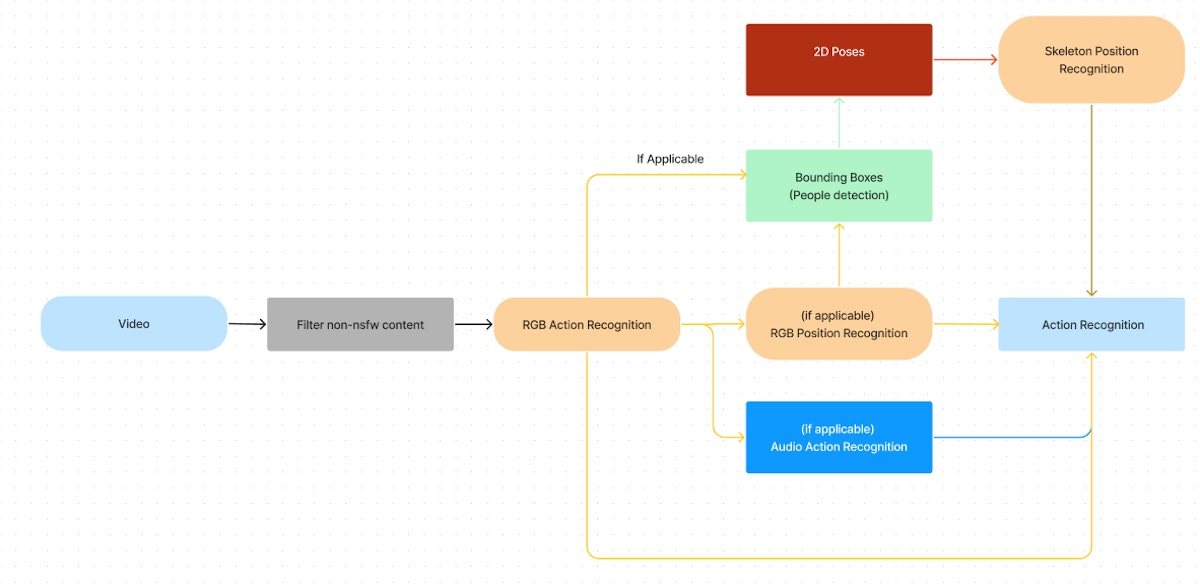
The illustration above provides an overview of the AI pipeline utilized in our system.

Initially, a lightweight NSFW detection model is employed to identify non-NSFW segments of the video, enabling us to bypass the rest of the pipeline for those sections. This approach not only accelerates the overall video inference time but also minimizes false positives. Running the action recognition models on irrelevant footage, such as a house or car, is unnecessary as they are not designed to recognize such content.

Following this preliminary step, we deploy a rapid RGB-based action recognition model. Depending on the top two results from this model, we determine whether to execute the RGB-based position recognition model, the audio-based action recognition model, or the skeleton-based action recognition model. If one of the top two predictions from the RGB-action recognition model corresponds to the position category, we proceed with the RGB-position recognition model to accurately identify the specific position.

Subsequently, we utilize bounding box and 2D pose models to extract the human skeleton, which is then input into the skeleton-based position recognition model. The results from the RGB-position recognition model and the skeleton-position recognition model are integrated through late fusion.

If the audio group is detected within the top two labels, the audio-based action recognition model is executed. Its results are combined with those of the RGB-action recognition model through late fusion.


Website: International Research Awards on Computer Vision #computervision #deeplearning #machinelearning #artificialintelligence #neuralnetworks,  #imageprocessing #objectdetection #imagerecognition #faceRecognition #augmentedreality #robotics #techtrends #3Dvision #professor #doctor #institute #sciencefather #researchawards #machinevision #visiontechnology #smartvision #patternrecognition #imageanalysis #semanticsegmentation #visualcomputing #datascience #techinnovation #university #lecture #biomedical

Visit Our Website : computer.scifat.com Nomination Link : computer-vision-conferences.scifat.com/award-nomination Registration Link : computer-vision-conferences.scifat.com/award-registration Member Link : computer-vision-conferences.scifat.com/conference-abstract-submission Awards-Winnerscomputer-vision-conferences.scifat.com/awards-winners Contact us : computer@scifat.com

Get Connected Here:
==================
Social Media Link

Universal Robots Showcases Deep Learning-Based Part Detection For Machine Tending Cobots At IMTS Robotics & Automation News


MENAFN- Robotics & automation News) Universal Robots showcases deep learning-based part detection for machine tending Cobots at IMTS

When Universal Robots (UR) recently surveyed 1,200 manufacturers across North America and Europe about their use of technology and future investment plans, over 50 percent of the respondents indicated they are now using AI and machine learning in their production processes.

AI isn't just hype,” says Ujjwal Kumar, group president of Teradyne Robotics, parent company of Universal Robots.

“We're seeing significant interest in physical AI. By adding high-performance compute hardware to our control systems and investing in targeted software upgrades, we're establishing UR as the preferred robotics platform for developing and deploying AI applications.”

At UR's IMTS booth #N 236131, September 9-14 in Chicago, the company will show a machine-tending application with new AI-based perception capabilities running on Nvidia Jetson and Isaac acceleration libraries integrated into UR's new PolyScope X platform.

This combination enables dynamic path planning, ensuring the robot takes the most effective, collision-free paths in and out of the machine without requiring extensive user configuration.

UR plans to make this cutting-edge technology available for a wide range of applications, including machine tending and other material handling tasks.

“We're looking forward to showing IMTS attendees robust deep learning solutions that will significantly impact manufacturing, especially for high mix/low volume production, which is increasingly common in machine tending,” Kumar adds.

AI will also be a focal point during UR's popular Cobot Walks - guided tours throughout IMTS that explore the latest cobot innovations in machine tending, metal fabricating, support tools, UR+ peripherals, and education.It's all about uptime

An important production parameter is cobot uptime. To ensure seamless operations and increased efficiency, UR has launched the enhanced UR Care Service Plans that now offer preventive field service, onsite break-fix, dedicated remote support and secure cloud connectivity-based cobot service/performance monitoring through UR Connect, showcased for the first time at IMTS.

“We want to be our customers' steadfast ally, helping them optimize performance, maintain peak hardware condition and uptime, and extend the lifespan of their cobots,” says Anurag Thakur, VP of service and aftermarket at UR, who also emphasizes UR Care's new Field Service program, an offering that both ensures prompt onsite repairs with industry-leading response times and preventive maintenance visits by skilled automation experts.

Unlike other service and repair offerings that often involve numerous platforms, channels, and logins, UR now provides all service, support, and training through the fleet management portal myUR.Flourishing ecosystem displays new cobot applications

With more than 60 collaborative robot arms from UR hard at work throughout the show floor at McCormick Place, IMTS 2024 is a testament to the rapidly expanding UR ecosystem with OEM, UR+, and Certified System Integrator partners exhibiting a wide range of UR cobot-powered applications.

The UR+ ecosystem recently hit a milestone, announcing 500 UR+ products. Some of these will be featured at IMTS including Groundlight AI; visual inspection and anomaly detection using AI, Zimmer's tool changing interface also compatible for Schmalz grippers, SICK's End-of-Arm Safeguard, Impaqt Robotics' pneumagiQ, a universal pneumatic gripper interface, and Olis Robotics' remote diagnostic and monitoring solution.


Website: International Research Awards on Computer Vision #computervision #deeplearning #machinelearning #artificialintelligence #neuralnetworks,  #imageprocessing #objectdetection #imagerecognition #faceRecognition #augmentedreality #robotics #techtrends #3Dvision #professor #doctor #institute #sciencefather #researchawards #machinevision #visiontechnology #smartvision #patternrecognition #imageanalysis #semanticsegmentation #visualcomputing #datascience #techinnovation #university #lecture #biomedical

Visit Our Website : computer.scifat.com Nomination Link : computer-vision-conferences.scifat.com/award-nomination Registration Link : computer-vision-conferences.scifat.com/award-registration Member Link : computer-vision-conferences.scifat.com/conference-abstract-submission Awards-Winnerscomputer-vision-conferences.scifat.com/awards-winners Contact us : computer@scifat.com

Get Connected Here:
==================
Social Media Link

Wednesday, September 11, 2024

New AI method captures uncertainty in medical images


In biomedicine, segmentation involves annotating pixels from an important structure in a medical image, like an organ or cell. Artificial intelligence models can help clinicians by highlighting pixels that may show signs of a certain disease or anomaly.


However, these models typically only provide one answer, while the problem of medical image segmentation is often far from black and white. Five expert human annotators might provide five different segmentations, perhaps disagreeing on the existence or extent of the borders of a nodule in a lung CT image.

“Having options can help in decision-making. Even just seeing that there is uncertainty in a medical image can influence someone’s decisions, so it is important to take this uncertainty into account,” says Marianne Rakic, an MIT computer science PhD candidate.

Rakic is lead author of a paper with others at MIT, the Broad Institute of MIT and Harvard, and Massachusetts General Hospital that introduces a new AI tool that can capture the uncertainty in a medical image.

Known as Tyche (named for the Greek divinity of chance), the system provides multiple plausible segmentations that each highlight slightly different areas of a medical image. A user can specify how many options Tyche outputs and select the most appropriate one for their purpose.

Importantly, Tyche can tackle new segmentation tasks without needing to be retrained. Training is a data-intensive process that involves showing a model many examples and requires extensive machine-learning experience.

Because it doesn’t need retraining, Tyche could be easier for clinicians and biomedical researchers to use than some other methods. It could be applied “out of the box” for a variety of tasks, from identifying lesions in a lung X-ray to pinpointing anomalies in a brain MRI.

Ultimately, this system could improve diagnoses or aid in biomedical research by calling attention to potentially crucial information that other AI tools might miss.

“Ambiguity has been understudied. If your model completely misses a nodule that three experts say is there and two experts say is not, that is probably something you should pay attention to,” adds senior author Adrian Dalca, an assistant professor at Harvard Medical School and MGH, and a research scientist in the MIT Computer Science and Artificial Intelligence Laboratory (CSAIL).

Their co-authors include Hallee Wong, a graduate student in electrical engineering and computer science; Jose Javier Gonzalez Ortiz PhD ’23; Beth Cimini, associate director for bioimage analysis at the Broad Institute; and John Guttag, the Dugald C. Jackson Professor of Computer Science and Electrical Engineering. Rakic will present Tyche at the IEEE Conference on Computer Vision and Pattern Recognition, where Tyche has been selected as a highlight.


Addressing ambiguity

AI systems for medical image segmentation typically use neural networks. Loosely based on the human brain, neural networks are machine-learning models comprising many interconnected layers of nodes, or neurons, that process data.

After speaking with collaborators at the Broad Institute and MGH who use these systems, the researchers realized two major issues limit their effectiveness. The models cannot capture uncertainty and they must be retrained for even a slightly different segmentation task.

Some methods try to overcome one pitfall, but tackling both problems with a single solution has proven especially tricky, Rakic says.

“If you want to take ambiguity into account, you often have to use an extremely complicated model. With the method we propose, our goal is to make it easy to use with a relatively small model so that it can make predictions quickly,” she says.

The researchers built Tyche by modifying a straightforward neural network architecture.

A user first feeds Tyche a few examples that show the segmentation task. For instance, examples could include several images of lesions in a heart MRI that have been segmented by different human experts so the model can learn the task and see that there is ambiguity.

The researchers found that just 16 example images, called a “context set,” is enough for the model to make good predictions, but there is no limit to the number of examples one can use. The context set enables Tyche to solve new tasks without retraining.

For Tyche to capture uncertainty, the researchers modified the neural network so it outputs multiple predictions based on one medical image input and the context set. They adjusted the network’s layers so that, as data move from layer to layer, the candidate segmentations produced at each step can “talk” to each other and the examples in the context set.

In this way, the model can ensure that candidate segmentations are all a bit different, but still solve the task.

“It is like rolling dice. If your model can roll a two, three, or four, but doesn’t know you have a two and a four already, then either one might appear again,” she says.

They also modified the training process so it is rewarded by maximizing the quality of its best prediction.

If the user asked for five predictions, at the end they can see all five medical image segmentations Tyche produced, even though one might be better than the others.

The researchers also developed a version of Tyche that can be used with an existing, pretrained model for medical image segmentation. In this case, Tyche enables the model to output multiple candidates by making slight transformations to images.


Better, faster predictions

When the researchers tested Tyche with datasets of annotated medical images, they found that its predictions captured the diversity of human annotators, and that its best predictions were better than any from the baseline models. Tyche also performed faster than most models.

“Outputting multiple candidates and ensuring they are different from one another really gives you an edge,” Rakic says.

The researchers also saw that Tyche could outperform more complex models that have been trained using a large, specialized dataset.

For future work, they plan to try using a more flexible context set, perhaps including text or multiple types of images. In addition, they want to explore methods that could improve Tyche’s worst predictions and enhance the system so it can recommend the best segmentation candidates.

This research is funded, in part, by the National Institutes of Health, the Eric and Wendy Schmidt Center at the Broad Institute of MIT and Harvard, and Quanta Computer.


Website: International Research Awards on Computer Vision #computervision #deeplearning #machinelearning #artificialintelligence #neuralnetworks,  #imageprocessing #objectdetection #imagerecognition #faceRecognition #augmentedreality #robotics #techtrends #3Dvision #professor #doctor #institute #sciencefather #researchawards #machinevision #visiontechnology #smartvision #patternrecognition #imageanalysis #semanticsegmentation #visualcomputing #datascience #techinnovation #university #lecture #biomedical

Visit Our Website : computer.scifat.com Nomination Link : computer-vision-conferences.scifat.com/award-nomination Registration Link : computer-vision-conferences.scifat.com/award-registration Member Link : computer-vision-conferences.scifat.com/conference-abstract-submission Awards-Winnerscomputer-vision-conferences.scifat.com/awards-winners Contact us : computer@scifat.com

Get Connected Here:
==================
Social Media Link