Thursday, September 12, 2024

P-HAR: Pornographic Human Action Recognition


Human action recognition has emerged as an active area of research within the deep learning community. The primary objective involves identifying and categorizing human actions in videos by utilizing multiple input streams, such as video and audio data.

One particular application of this technology lies in the pornography domain, which poses unique technical challenges that complicate the process of human action recognition. Factors such as lighting variations, occlusions, and substantial differences in camera angles and filming techniques make action recognition difficult.

Even when two actions are identical, the diverse camera perspectives can lead to confusion in model predictions. To address these challenges in the pornography domain, we have employed deep learning techniques that learn from various input streams, including RGB, Skeleton (Pose), and Audio data. The most effective models in terms of performance and runtime include transformer-based architectures for the RGB stream, PoseC3D for the skeleton stream, and ResNet101 for the audio stream.

The outputs of these models are combined using late fusion, wherein each model's significance in the final scoring scheme differs. An alternative strategy might involve training a model with two input streams simultaneously, such as RGB+skeleton or RGB+audio, and subsequently merging their results. However, this approach is unsuitable due to the data's inherent properties.

Audio input streams are only useful for specific actions, while other actions lack distinct audio characteristics. Similarly, the skeleton-based model is only applicable when pose estimation surpasses a certain confidence threshold, which is challenging to attain for some actions.

By employing the late fusion technique, detailed in subsequent sections, we attain an impressive 90% accuracy rate for the top two predictions among 20 distinct categories. These categories encompass a diverse range of sexual actions and positions.


Models
RGB Input Stream

The primary and most reliable input stream for the model is the RGB frames. The two most potent architectures in this context are the 3D Convolutional Neural Networks (3D CNNs) and attention-based models. The attention-based models, particularly those utilizing transformer architectures, are currently considered state-of-the-art in the field. Consequently, we employ a transformer-based architecture to achieve optimal performance. Additionally, the model demonstrates rapid inference capabilities, requiring approximately 0.53 seconds to process 7-second video clips.
Skeleton Input Stream

Initially, the human skeleton is extracted utilizing a human detection and 2D pose estimation model. The extracted skeleton information is subsequently fed into PoseC3D, a 3D Convolutional Neural Network (3D CNN) specifically designed for skeleton-based human action recognition. This model is also considered state-of-the-art in the field. In addition to its performance, the PoseC3D model exhibits efficient inference capabilities, requiring approximately 3 seconds to process 7-second video clips.

Owing to the challenging perspectives encountered in numerous actions (e.g. it's not possible to extract reliable poses that will help a model identify a fingering action most of the time), skeleton-based human action recognition is employed selectively, specifically for a subset of actions, which includes sex positions


Audio Input Stream

For the audio input stream, a ResNet-based architecture derived from the Audiovisual SlowFast model is employed. This approach is applied to a smaller set of actions compared to the skeleton-based method, primarily due to the limited information available from an audio perspective for reliably identifying actions within this specific domain.


Dataset

The assembled dataset is extensive and heterogeneous, incorporating a wide range of recording types, including point-of-view (POV), professional, amateur, with or without a dedicated camera operator, and varying background environments, individuals, and camera perspectives. The dataset comprises approximately 100 hours of training data spanning 20 distinct categories. However, some category imbalances were observed in the dataset. Efforts to address these imbalances are being considered for future iterations of the dataset.


Architecture
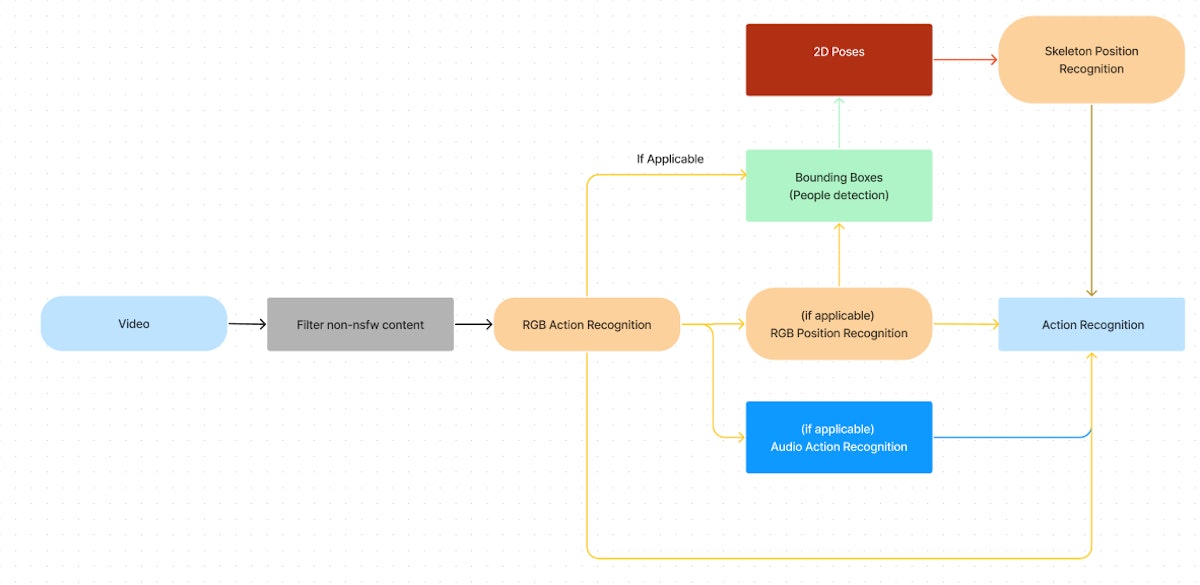


The illustration above provides an overview of the AI pipeline utilized in our system.

Initially, a lightweight NSFW detection model is employed to identify non-NSFW segments of the video, enabling us to bypass the rest of the pipeline for those sections. This approach not only accelerates the overall video inference time but also minimizes false positives. Running the action recognition models on irrelevant footage, such as a house or car, is unnecessary as they are not designed to recognize such content.

Following this preliminary step, we deploy a rapid RGB-based action recognition model. Depending on the top two results from this model, we determine whether to execute the RGB-based position recognition model, the audio-based action recognition model, or the skeleton-based action recognition model. If one of the top two predictions from the RGB-action recognition model corresponds to the position category, we proceed with the RGB-position recognition model to accurately identify the specific position.

Subsequently, we utilize bounding box and 2D pose models to extract the human skeleton, which is then input into the skeleton-based position recognition model. The results from the RGB-position recognition model and the skeleton-position recognition model are integrated through late fusion.

If the audio group is detected within the top two labels, the audio-based action recognition model is executed. Its results are combined with those of the RGB-action recognition model through late fusion.


Website: International Research Awards on Computer Vision #computervision #deeplearning #machinelearning #artificialintelligence #neuralnetworks,  #imageprocessing #objectdetection #imagerecognition #faceRecognition #augmentedreality #robotics #techtrends #3Dvision #professor #doctor #institute #sciencefather #researchawards #machinevision #visiontechnology #smartvision #patternrecognition #imageanalysis #semanticsegmentation #visualcomputing #datascience #techinnovation #university #lecture #biomedical

Visit Our Website : computer.scifat.com Nomination Link : computer-vision-conferences.scifat.com/award-nomination Registration Link : computer-vision-conferences.scifat.com/award-registration Member Link : computer-vision-conferences.scifat.com/conference-abstract-submission Awards-Winners : computer-vision-conferences.scifat.com/awards-winners Contact us : computer@scifat.com

Get Connected Here:
==================
Social Media Link

Universal Robots Showcases Deep Learning-Based Part Detection For Machine Tending Cobots At IMTS Robotics & Automation News


MENAFN- Robotics & automation News) Universal Robots showcases deep learning-based part detection for machine tending Cobots at IMTS

When Universal Robots (UR) recently surveyed 1,200 manufacturers across North America and Europe about their use of technology and future investment plans, over 50 percent of the respondents indicated they are now using AI and machine learning in their production processes.

“AI isn't just hype,” says Ujjwal Kumar, group president of Teradyne Robotics, parent company of Universal Robots.

“We're seeing significant interest in physical AI. By adding high-performance compute hardware to our control systems and investing in targeted software upgrades, we're establishing UR as the preferred robotics platform for developing and deploying AI applications.”

At UR's IMTS booth #N 236131, September 9-14 in Chicago, the company will show a machine-tending application with new AI-based perception capabilities running on Nvidia Jetson and Isaac acceleration libraries integrated into UR's new PolyScope X platform.

This combination enables dynamic path planning, ensuring the robot takes the most effective, collision-free paths in and out of the machine without requiring extensive user configuration.

UR plans to make this cutting-edge technology available for a wide range of applications, including machine tending and other material handling tasks.

“We're looking forward to showing IMTS attendees robust deep learning solutions that will significantly impact manufacturing, especially for high mix/low volume production, which is increasingly common in machine tending,” Kumar adds.

AI will also be a focal point during UR's popular Cobot Walks - guided tours throughout IMTS that explore the latest cobot innovations in machine tending, metal fabricating, support tools, UR+ peripherals, and education.It's all about uptime

An important production parameter is cobot uptime. To ensure seamless operations and increased efficiency, UR has launched the enhanced UR Care Service Plans that now offer preventive field service, onsite break-fix, dedicated remote support and secure cloud connectivity-based cobot service/performance monitoring through UR Connect, showcased for the first time at IMTS.

“We want to be our customers' steadfast ally, helping them optimize performance, maintain peak hardware condition and uptime, and extend the lifespan of their cobots,” says Anurag Thakur, VP of service and aftermarket at UR, who also emphasizes UR Care's new Field Service program, an offering that both ensures prompt onsite repairs with industry-leading response times and preventive maintenance visits by skilled automation experts.

Unlike other service and repair offerings that often involve numerous platforms, channels, and logins, UR now provides all service, support, and training through the fleet management portal myUR.Flourishing ecosystem displays new cobot applications

With more than 60 collaborative robot arms from UR hard at work throughout the show floor at McCormick Place, IMTS 2024 is a testament to the rapidly expanding UR ecosystem with OEM, UR+, and Certified System Integrator partners exhibiting a wide range of UR cobot-powered applications.

The UR+ ecosystem recently hit a milestone, announcing 500 UR+ products. Some of these will be featured at IMTS including Groundlight AI; visual inspection and anomaly detection using AI, Zimmer's tool changing interface also compatible for Schmalz grippers, SICK's End-of-Arm Safeguard, Impaqt Robotics' pneumagiQ, a universal pneumatic gripper interface, and Olis Robotics' remote diagnostic and monitoring solution.


Website: International Research Awards on Computer Vision #computervision #deeplearning #machinelearning #artificialintelligence #neuralnetworks,  #imageprocessing #objectdetection #imagerecognition #faceRecognition #augmentedreality #robotics #techtrends #3Dvision #professor #doctor #institute #sciencefather #researchawards #machinevision #visiontechnology #smartvision #patternrecognition #imageanalysis #semanticsegmentation #visualcomputing #datascience #techinnovation #university #lecture #biomedical

Visit Our Website : computer.scifat.com Nomination Link : computer-vision-conferences.scifat.com/award-nomination Registration Link : computer-vision-conferences.scifat.com/award-registration Member Link : computer-vision-conferences.scifat.com/conference-abstract-submission Awards-Winners : computer-vision-conferences.scifat.com/awards-winners Contact us : computer@scifat.com

Get Connected Here:
==================
Social Media Link

Wednesday, September 11, 2024

New AI method captures uncertainty in medical images


In biomedicine, segmentation involves annotating pixels from an important structure in a medical image, like an organ or cell. Artificial intelligence models can help clinicians by highlighting pixels that may show signs of a certain disease or anomaly.


However, these models typically only provide one answer, while the problem of medical image segmentation is often far from black and white. Five expert human annotators might provide five different segmentations, perhaps disagreeing on the existence or extent of the borders of a nodule in a lung CT image.

“Having options can help in decision-making. Even just seeing that there is uncertainty in a medical image can influence someone’s decisions, so it is important to take this uncertainty into account,” says Marianne Rakic, an MIT computer science PhD candidate.

Rakic is lead author of a paper with others at MIT, the Broad Institute of MIT and Harvard, and Massachusetts General Hospital that introduces a new AI tool that can capture the uncertainty in a medical image.

Known as Tyche (named for the Greek divinity of chance), the system provides multiple plausible segmentations that each highlight slightly different areas of a medical image. A user can specify how many options Tyche outputs and select the most appropriate one for their purpose.

Importantly, Tyche can tackle new segmentation tasks without needing to be retrained. Training is a data-intensive process that involves showing a model many examples and requires extensive machine-learning experience.

Because it doesn’t need retraining, Tyche could be easier for clinicians and biomedical researchers to use than some other methods. It could be applied “out of the box” for a variety of tasks, from identifying lesions in a lung X-ray to pinpointing anomalies in a brain MRI.

Ultimately, this system could improve diagnoses or aid in biomedical research by calling attention to potentially crucial information that other AI tools might miss.

“Ambiguity has been understudied. If your model completely misses a nodule that three experts say is there and two experts say is not, that is probably something you should pay attention to,” adds senior author Adrian Dalca, an assistant professor at Harvard Medical School and MGH, and a research scientist in the MIT Computer Science and Artificial Intelligence Laboratory (CSAIL).

Their co-authors include Hallee Wong, a graduate student in electrical engineering and computer science; Jose Javier Gonzalez Ortiz PhD ’23; Beth Cimini, associate director for bioimage analysis at the Broad Institute; and John Guttag, the Dugald C. Jackson Professor of Computer Science and Electrical Engineering. Rakic will present Tyche at the IEEE Conference on Computer Vision and Pattern Recognition, where Tyche has been selected as a highlight.


Addressing ambiguity

AI systems for medical image segmentation typically use neural networks. Loosely based on the human brain, neural networks are machine-learning models comprising many interconnected layers of nodes, or neurons, that process data.

After speaking with collaborators at the Broad Institute and MGH who use these systems, the researchers realized two major issues limit their effectiveness. The models cannot capture uncertainty and they must be retrained for even a slightly different segmentation task.

Some methods try to overcome one pitfall, but tackling both problems with a single solution has proven especially tricky, Rakic says.

“If you want to take ambiguity into account, you often have to use an extremely complicated model. With the method we propose, our goal is to make it easy to use with a relatively small model so that it can make predictions quickly,” she says.

The researchers built Tyche by modifying a straightforward neural network architecture.

A user first feeds Tyche a few examples that show the segmentation task. For instance, examples could include several images of lesions in a heart MRI that have been segmented by different human experts so the model can learn the task and see that there is ambiguity.

The researchers found that just 16 example images, called a “context set,” is enough for the model to make good predictions, but there is no limit to the number of examples one can use. The context set enables Tyche to solve new tasks without retraining.

For Tyche to capture uncertainty, the researchers modified the neural network so it outputs multiple predictions based on one medical image input and the context set. They adjusted the network’s layers so that, as data move from layer to layer, the candidate segmentations produced at each step can “talk” to each other and the examples in the context set.

In this way, the model can ensure that candidate segmentations are all a bit different, but still solve the task.

“It is like rolling dice. If your model can roll a two, three, or four, but doesn’t know you have a two and a four already, then either one might appear again,” she says.

They also modified the training process so it is rewarded by maximizing the quality of its best prediction.

If the user asked for five predictions, at the end they can see all five medical image segmentations Tyche produced, even though one might be better than the others.

The researchers also developed a version of Tyche that can be used with an existing, pretrained model for medical image segmentation. In this case, Tyche enables the model to output multiple candidates by making slight transformations to images.


Better, faster predictions

When the researchers tested Tyche with datasets of annotated medical images, they found that its predictions captured the diversity of human annotators, and that its best predictions were better than any from the baseline models. Tyche also performed faster than most models.

“Outputting multiple candidates and ensuring they are different from one another really gives you an edge,” Rakic says.

The researchers also saw that Tyche could outperform more complex models that have been trained using a large, specialized dataset.

For future work, they plan to try using a more flexible context set, perhaps including text or multiple types of images. In addition, they want to explore methods that could improve Tyche’s worst predictions and enhance the system so it can recommend the best segmentation candidates.

This research is funded, in part, by the National Institutes of Health, the Eric and Wendy Schmidt Center at the Broad Institute of MIT and Harvard, and Quanta Computer.


Website: International Research Awards on Computer Vision #computervision #deeplearning #machinelearning #artificialintelligence #neuralnetworks,  #imageprocessing #objectdetection #imagerecognition #faceRecognition #augmentedreality #robotics #techtrends #3Dvision #professor #doctor #institute #sciencefather #researchawards #machinevision #visiontechnology #smartvision #patternrecognition #imageanalysis #semanticsegmentation #visualcomputing #datascience #techinnovation #university #lecture #biomedical

Visit Our Website : computer.scifat.com Nomination Link : computer-vision-conferences.scifat.com/award-nomination Registration Link : computer-vision-conferences.scifat.com/award-registration Member Link : computer-vision-conferences.scifat.com/conference-abstract-submission Awards-Winners : computer-vision-conferences.scifat.com/awards-winners Contact us : computer@scifat.com

Get Connected Here:
==================
Social Media Link

Tuesday, September 10, 2024

An artificial intelligence primer – from machine learning to computer vision


Artificial intelligence has the potential to impact almost every area of life. In this first of a two-part series explaining the technology behind the headlines, this article looks at the different branches of AI technology, and what they can do


When we think of artificial intelligence (AI), most of us teeter between excitement and concern about its rise. And with AI, just like anything, the unknowns fuel our concerns.

AI and generative AI are unleashing amazing opportunities that will enable governments to be much more productive and effective – getting more done – better, faster, and easier. These technologies will enable us to run virtual simulations before taking real actions, prevent adverse events, prepare for changing conditions, detect areas of concern sooner and with greater accuracy, engage in more meaningful ways, and manage our resources better.
So, what is AI?

Artificial intelligence is the science of designing systems to support and accelerate human decisions and actions. These systems perform tasks that have historically required human intelligence But, it’s called artificial intelligence for a reason: the simulation of human intelligence is performed by machines that have been programmed to learn and think. AI does not replace humans; it augments and accelerates what we do and how we do it, increasing overall efficiency and productivity.


When we talk about the different types of AI, we sometimes refer to them as “branches of AI.” Each branch performs different types of tasks. Three of the traditional branches of AI used by governments are machine learning, computer vision, and natural language processing. These three branches of AI are interconnected and often overlap, with advancements in one area often influencing progress in others.

And, generative AI – or GenAI – is a subset of deep learning, which in turn is a subset of Machine Learning. Technologies within GenAI include lqrge language models (referred to as LLMs), ans Synthetic Data.

For those of you who have been hearing a lot about or using ChatGPT or Copilot, these are built on an LLM.

Before we talk about generative AI, let’s discuss traditional AI technologies and how they work.
Machine learning

Machine learning systems learn from data, identify patterns, and make decisions with minimal human intervention.

You may have taken a computer class at some point in which you wrote conditional, or If-Then, statements.

For example, an estate agent might say that “if the property is adjacent to a lake, increase its value by 10%.”

But machine learning does not require you to write “if then” statements. Machine learning models learn from the data that is fed into it. – and the more data you feed the model, the more accurate the model becomes.

The machine is able to ingest massive amounts of data, extract key features, determine a method of analysis, write the code to execute that analysis, and produce an intelligent output – all through an automated process.

For example, imagine a computer assessing the value of properties. The computer considers thousands of properties. It compares properties next to water features against those that are not. From the data that it reads, the computer determines that properties adjacent to lakes are 11% more valuable than those that are not. The rule does not become a fixed rule. In fact, any change to the data fed into the system will change the rules and the output. Typically, the more data that a system processes, the more refined the answers become.
Deep Learning

Deep learning is a subset of machine learning that teaches computers to process data in a way that is inspired by the human brain. In the same manner that the neurons in the brain send information between brain cells, layers of nodes in deep learning work together to process data and solve problems. Deep Learning can be compared to the process of teaching a child to recognize animals through layers of learning, constant testing and correction, and enough diverse examples to ensure he can generalize to new situations. Deep Learning, like the child, improves with practice, refining its understanding with each new example. Deep learning is used for Natural Language Processing, Computer Vision, and Generative AI.

Natural language processing

Natural language processing enables understanding, interaction and communication between humans and machines.

NLP makes it possible for computers to read text, hear speech, interpret it, measure sentiment, and determine which parts are important. The overarching goal is to take raw language input and use linguistics and algorithms to transform or enrich the text in such a way that it delivers greater value.

Natural language processing goes hand in hand with text analytics, a machine learning technique that counts, groups, and categorizes words to extract structure and meaning from large volumes of content.

All these branches of AI contribute to one another. The computer can augment human efforts to analyse unstructured text with AI using a combination of natural language processing, machine learning, and linguistic rules. NLP and text analytics are used together for many applications, including investigative discovery, subject-matter expertise, and social media analytics.

For example, crime investigations typically involve a massive amount of intelligence reports. Not only are these reports extremely time consuming to read, the process of extracting key people, addresses, phone numbers, and relationships that are pertinent evidence to a case can be cumbersome. New information learned from a crime report demands scouring previously-read reports, making the process repetitive and lengthy.

Using ML, the people, places, events, objects, phone numbers, and email addresses can be extracted out of long-form text like crime reports and put into tables. This expedites the discovery of information.

Applying linguistics and analytics, an NLP system can extrapolate nuances such as sentiment from sentences within a report. This is accomplished by discerning the syntax – structure, arrangement, and order of words and phrases , semantics –the meaning of words, phrases, and sentences, and the “discourse” – the analysis of language that focuses on how language is used in context to convey meaning.


Computer vision

Computer vision is a field of AI that trains computers to interpret and understand the visual world. Computer vision enables systems to see, identify, and process images or videos in the same way that human vision does.

Machines can use deep learning algorithms to accurately identify and classify objects in images and videos — and then react to what they “see.”

Applications of computer vision include facial recognition and surveillance image analysis.

This graphic illustrates how computer vision works.

On the left, you see a portrait of a famous American. The image is pixelized and then a number is assigned to each pixel shade. On the right, you see how the computer defines the image.

Many different techniques of computer vision can be used to analyze images or video. A few of these are:Image segmentation which partitions an image into multiple regions or pieces to be examined separately.

Object detection which identifies a specific object in an image or advanced object detection which recognizes many objects in a single image: a playing field, an offensive player, a defensive player, a ball and so on. These models use an X,Y coordinate to create a bounding box and identify everything inside the box.

Pattern detection is a process of recognizing repeated shapes, colors, and other visual indicators in images.

Edge detection is a technique used to identify the outside edge of an object or landscape to better identify what is in the image.

Image classification which groups images into different categories.

Feature matching which is a type of pattern detection that matches similarities in images to help classify them.

This is the first of a two part series looking at how AI and Generative AI work, to help public servants become familiar with the characteristics and functions of different AI technologies and to understand the types of AI needed to address different tasks. Keep an eye out for the next article on generative AI.


Website: International Research Awards on Computer Vision #computervision #deeplearning #machinelearning #artificialintelligence #neuralnetworks,  #imageprocessing #objectdetection #imagerecognition #faceRecognition #augmentedreality #robotics #techtrends #3Dvision #professor #doctor #institute #sciencefather #researchawards #machinevision #visiontechnology #smartvision #patternrecognition #imageanalysis #semanticsegmentation #visualcomputing #datascience #techinnovation #university #lecture #biomedical

Visit Our Website : computer.scifat.com Nomination Link : computer-vision-conferences.scifat.com/award-nomination Registration Link : computer-vision-conferences.scifat.com/award-registration Member Link : computer-vision-conferences.scifat.com/conference-abstract-submission Awards-Winners : computer-vision-conferences.scifat.com/awards-winners Contact us : computer@scifat.com

Get Connected Here:
==================
Social Media Link

Monday, September 9, 2024

Game Theory unveils G.O.A.T Vision, AI-Driven computer vision technology touted to be the future of Sports


Game Theory exhibited their tech prowess and showcased the future of sports globally with their groundbreaking AI-driven computer vision technology – G.O.A.T Vision. This event showcased how pro-sports technology will make playing sports a habit and part of everyone’s lifestyle


On the occasion of National Sports Day, Game Theory offered a sneak peek into this cutting-edge technology, which represented just the beginning of a transformative journey for players of all sports across the world. For the first time, players were able to access insights around errors, winners, and detailed statistics such as calories burned and distance covered, playing intensity and effort scores without use of any wearable devices They were also provided highlight reels, best smashes, great rallies and many other game attributes.all automatically generated through their state of the art computer vision algorithms and AI.

For Game Theory users, this new technology launch marks a significant leap forward gamifying their experience with pro insights. The new launch is guaranteed to create a richer and more immersive experience with technology seamlessly working it’s magic in the background. From real-time score displays on large screens to video highlights where they are the ‘star’ and talking points after each game, the enhancements are designed to make every session more engaging, memorable and fun. Game Theory’s latest tech captures 100,000 frames per hour of game play and with 150,000 games worth of historical data making this far richer than anything else out there.

The base technology that was showcased for Badminton at the event today and will also be rolled out very soon for other sports like Pickleball, Swimming, Paddle Tennis, Tennis, Table Tennis, Squash, Basketball and many other sports to be introduced at state-of-the-art Game Theory facilities.

“This is just a glimpse into our vision and AI journey,” Sudeep Kulkarni, Founder & CEO, Game Theory. “We’re really excited to showcase how our tech will evolve to create social communities, rank players according to their skills, put players on their personal fitness paths and automatically organise ladder and league tournaments. What we’re presenting today is just 5% of what we are building toward. There’s so much more to come.”

The exhibition featured live demos, including a match with real-time stats displayed on LED screens, giving attendees a firsthand look at the future of amateur sports. With the ability to see the speed of a smash or the intensity of a rally, this technology brought a level of detail previously reserved for professional sports broadcasts.

The event took place on 29th August from 9:30 AM to 1:00 PM at Game Theory Double Road Indiranagar – Badminton Court. The agenda began at 10:00 AM with a keynote by Sudeep Kulkarni, Founder, on the democratisation of computer vision technology, followed by Chief Technology Officer Saket’s vision for the future of Game Theory’s technology at 10:15 AM. At 10:25 AM, Ganesh, who specialises in Computer Vision, discussed the potential of this innovative technology, and at 10:30 AM, COO Sukrut explored its applications in coaching, community building, and player statistics. Harsha from the Product team then demonstrated the current app and product features at 10:45 AM. The event concluded with a live demo match at 10:55 AM, featuring real-time stats and commentary.


Website: International Research Awards on Computer Vision #computervision #deeplearning #machinelearning #artificialintelligence #neuralnetworks,  #imageprocessing #objectdetection #imagerecognition #faceRecognition #augmentedreality #robotics #techtrends #3Dvision #professor #doctor #institute #sciencefather #researchawards #machinevision #visiontechnology #smartvision #patternrecognition #imageanalysis #semanticsegmentation #visualcomputing #datascience #techinnovation #university #lecture #biomedical

Visit Our Website : computer.scifat.com Nomination Link : computer-vision-conferences.scifat.com/award-nomination Registration Link : computer-vision-conferences.scifat.com/award-registration Member Link : computer-vision-conferences.scifat.com/conference-abstract-submission Awards-Winners : computer-vision-conferences.scifat.com/awards-winners Contact us : computer@scifat.com

Get Connected Here:
==================
Social Media Link

Wednesday, September 4, 2024

AI Data Mining Uses Machine Learning to Glean Insights


In an era where data is often called the new oil, artificial intelligence (AI) is the tool extracting valuable insights from vast digital reserves. AI-powered data mining, a technology at the intersection of machine learning and big data analytics, is reshaping industries and driving decision-making across the corporate landscape.


Companies are using AI-powered data mining techniques to gain a competitive edge in areas ranging from predicting consumer behavior to optimizing supply chains. However, as these technologies become more pervasive, they also raise questions about privacy, ethics and the future of work.

Unlike crypto mining, which focuses on generating digital currency, data mining generates insights from large datasets to inform business decisions. Both processes involve using computer power to uncover hidden value in digital information.


The Mechanics of AI Data Mining

At its core, AI data mining involves using machine learning algorithms to identify patterns and meaningful information from large datasets. Unlike traditional data analysis methods, which often rely on predetermined rules, AI systems can adapt and improve their performance over time as they process more data.

One of the most widely used techniques in AI data mining is deep learning, a subset of machine learning based on artificial neural networks. Inspired by the human brain, these systems can process complex, unstructured data such as images, text and audio.


Real-World Applications

The applications of AI data mining span various sectors, with some of the most notable examples found in finance, healthcare and retail.

Companies like JPMorgan Chase have implemented AI systems to analyze vast amounts of financial data and detect fraudulent transactions in the financial sector. The bank’s Contract Intelligence (COiN) platform uses natural language processing to review commercial loan agreements, which previously took 360,000 hours of work by lawyers and loan officers annually.

Healthcare providers are leveraging AI data mining to improve patient outcomes and streamline operations. For instance, the Mayo Clinic has partnered with Google Cloud to develop AI algorithms that can analyze medical imaging data to detect diseases earlier and more accurately than traditional methods.

In retail, Amazon’s recommendation engine drives up to 35% of the company’s revenue and is a prime example of AI data mining. The system analyzes customers’ browsing history, purchase patterns and other data points to suggest products they will likely buy.
AI Data Mining in eCommerce

AI data mining techniques have also made waves in the eCommerce sector. Online retailers use these technologies to personalize the shopping experience, optimize pricing strategies and manage inventory.

Personalization engines, powered by AI data mining, analyze vast amounts of customer data to create tailored product recommendations and marketing messages. For instance, Stitch Fix, an online personal styling service, uses AI to analyze customer preferences and feedback to curate personalized clothing selections.

Dynamic pricing, another application of AI data mining in eCommerce, allows retailers to adjust prices in real time based on factors such as demand, competitor pricing and even weather conditions. Airlines and hotels have long used this technique, but it’s also becoming common in online retail.

AI data mining also transforms supply chain management and demand forecasting in the commercial sector. By analyzing historical sales data, social media trends and even macroeconomic indicators, AI systems can predict future demand with new accuracy.

Walmart, for example, uses AI-powered forecasting tools to optimize its supply chain. These systems analyze data from the company’s 11,000+ stores and eCommerce sites to predict demand for millions of products, helping to reduce stockouts and overstock situations.

In manufacturing, companies use AI data mining to implement predictive maintenance programs. By analyzing data from sensors on manufacturing equipment, these systems can predict when a machine is likely to fail, allowing maintenance to be scheduled before a breakdown occurs.
Regulatory Landscape

Governments and regulatory bodies are grappling with balancing innovation with consumer protection in the age of AI data mining. The European Union’s General Data Protection Regulation (GDPR), implemented in 2018, set a new standard for data privacy, including provisions explicitly addressing AI and automated decision-making.

While there is no comprehensive federal AI regulation in the United States, various agencies are taking steps to address the technology. The Federal Trade Commission has signaled increased scrutiny of AI applications, particularly those that could result in bias or consumer harm.

As AI data mining technologies evolve, their impact on business and society will likely grow as they offer more robust data analysis capabilities.


Website: International Research Awards on Computer Vision #computervision #deeplearning #machinelearning #artificialintelligence #neuralnetworks,  #imageprocessing #objectdetection #imagerecognition #faceRecognition #augmentedreality #robotics #techtrends #3Dvision #professor #doctor #institute #sciencefather #researchawards #machinevision #visiontechnology #smartvision #patternrecognition #imageanalysis #semanticsegmentation #visualcomputing #datascience #techinnovation #university #lecture #biomedical

Visit Our Website : computer.scifat.com Nomination Link : computer-vision-conferences.scifat.com/award-nomination Registration Link : computer-vision-conferences.scifat.com/award-registration Member Link : computer-vision-conferences.scifat.com/conference-abstract-submission Awards-Winners : computer-vision-conferences.scifat.com/awards-winners Contact us : computer@scifat.com

Get Connected Here:
==================
Social Media Link

Tuesday, September 3, 2024

Analyzing Building Features with Deep Learning Datasets


Background

Building characteristics play a critical role in construction management and architectural design. SSVIs can be analyzed with deep learning techniques to interpret building characteristics without a physical visit. They provide a human-like view of building facades, detailing materials, window types, etc. Thus, SSVIs can more cost-effectively and quickly identify building characteristics than actual site visits.

Facade datasets exist for tasks like window state recognition, tile defect categorization, window identification, and building segmentation. However, varying annotations are needed for diverse tasks even using similar images, which is inefficient and laborious. Moreover, no raw and labeled data is freely available for the following four tasks using SSVIs: categorizing the number of stories, usable SSVIs, building typologies, and external cladding materials.

Deep learning methods have high generalization capability and can automate many tasks involving SSVIs. Thus, this study aimed to establish labeled datasets for the four tasks that can help develop robust deep-learning models.


Data Description

Four tasks were constructed to classify the number of stories, building typologies, external cladding materials, and usable SSVIs. Among these, the number of stories dataset comprised images classified by their corresponding floors (1F to 5F, or others). The ‘others’ category in each dataset accounted for the images unrelated to the captured building characteristics for that task.


This task had 700 initial images, divided into 418 (80%) for training and 282 (20%) for testing. Alternatively, the dataset for categorizing building typologies included images categorized as residential and non-residential. The initial 450 images collected for this task were divided into 270 (80%) for training and 180 (20%) for testing.

The dataset of usable SSVIs was differentiated for the complete building facade and first-story building, categorizing the images as usable, potential, and non-usable in both cases. While the former used 1000 raw images (divided into 600 (60%) for training, 200 (20%) for validation, and 200 (20%) for testing), the latter used 700 raw images (divided into 418 (60%) for training, 140 (20%) for validation, and 142 (20%) for testing). The augmentation methods generated 3600 augmented images in each case.

The dataset for analyzing external cladding materials categorized images by type, i.e., brick, concrete, glass, stone, mixed, and others. The ‘others’ category accounted for rare textures and appearances like wood, metal, and synthetic sidings. This dataset used 1550 raw images from London (split into 928 (60%) for training, 311 (20%) for validation, and 311 (20%) for testing) and 1017 from Scotland (split into 608 (60%) for training, 204 (20%) for validation, and 205 (20%) for testing). Accordingly, 5568 augmented images for London and 3648 for Scotland were generated.
Methods

The original dataset was prepared using SSVIs captured from buildings in London and Scotland. Their addresses were obtained from the United Kingdom’s national mapping agency (Ordnance Survey Data Hub). A sample of buildings was randomly chosen from the northwest and eastern regions.

Building images were downloaded from GSV (Google Street View) Static API (Application Programming Interface) using the selected addresses. Specific API parameters were manually altered to optimize visual hints for identifying building characteristics across the four tasks. For instance, the ‘Field of View’ parameter was set between 10-50 degrees, and the ‘pitch’ parameter was set between 25-30 degrees. The resolution of the captured images was 640×640 pixels, the maximum of the GSV platform.

Augmentation techniques (brightness, contrast, perspective, rotation, scale, shear, translation) applied exclusively to the training subset in each category resulted in nine different datasets. The parameters of these image augmentation techniques were selected through a trial-and-error method to generate close-to-reality images. Each augmentation technique effectively doubled the number of images. Notably, the voids in these images were filled with 255-value pixels to pad these areas with white.


Conclusion

Overall, the researchers prepared a detailed dataset to classify the number of stories, building typologies, exterior cladding materials, and usable SSVIs. The well-labeled dataset can serve as a foundational basis for training and validating deep-learning algorithms, paving the way for advancements in building management and design.

However, the dataset has certain limitations such as its geographic specificity. It captures the architectural styles, materials, and environmental conditions unique to the buildings in London and Scotland and may not represent the global architectural diversity. Moreover, the captured image resolution is enough for the targeted tasks in this dataset but may not suffice for comprehensive tasks like crack recognition, crack segmentation, and tile segmentation.

Thus, the dataset needs to be complemented with additional data from diverse regions, building types, and temporal settings to improve the robustness and applicability of the models trained on it.


Website: International Research Awards on Computer Vision #computervision #deeplearning #machinelearning #artificialintelligence #neuralnetworks,  #imageprocessing #objectdetection #imagerecognition #faceRecognition #augmentedreality #robotics #techtrends #3Dvision #professor #doctor #institute #sciencefather #researchawards #machinevision #visiontechnology #smartvision #patternrecognition #imageanalysis #semanticsegmentation #visualcomputing #datascience #techinnovation #university #lecture #biomedical

Visit Our Website : computer.scifat.com Nomination Link : computer-vision-conferences.scifat.com/award-nomination Registration Link : computer-vision-conferences.scifat.com/award-registration Member Link : computer-vision-conferences.scifat.com/conference-abstract-submission Awards-Winners : computer-vision-conferences.scifat.com/awards-winners Contact us : computer@scifat.com

Get Connected Here:
==================
Social Media Link