Monday, July 29, 2024

Neural networks made of light can make machine learning more sustainable


Scientists propose a new way of implementing a neural network with an optical system which could make machine learning more sustainable in the future. The researchers at the Max Planck Institute for the Science of Light have published their new method in Nature Physics, demonstrating a method that is much simpler than previous approaches.


Machine learning and artificial intelligence are becoming increasingly widespread, with applications ranging from computer vision to text generation, as demonstrated by ChatGPT. However, these complex tasks require increasingly complex neural networks; some with many billion parameters.

This rapid growth of neural network size has put the technologies on an unsustainable path due to their exponentially growing energy consumption and training times. For instance, it is estimated that training GPT-3 consumed more than 1,000 MWh of energy, which amounts to the daily electrical energy consumption of a small town.

This trend has created a need for faster, more energy- and cost-efficient alternatives, sparking the rapidly developing field of neuromorphic computing. The aim of this field is to replace the neural networks on our digital computers with physical neural networks. These are engineered to perform the required mathematical operations physically in a potentially faster and more energy-efficient way.

Optics and photonics are particularly promising platforms for neuromorphic computing since energy consumption can be kept to a minimum. Computations can be performed in parallel at very high speeds only limited by the speed of light. However, so far, there have been two significant challenges: First, realizing the necessary complex mathematical computations requires high laser powers. Second, the lack of an efficient general training method for such physical neural networks.
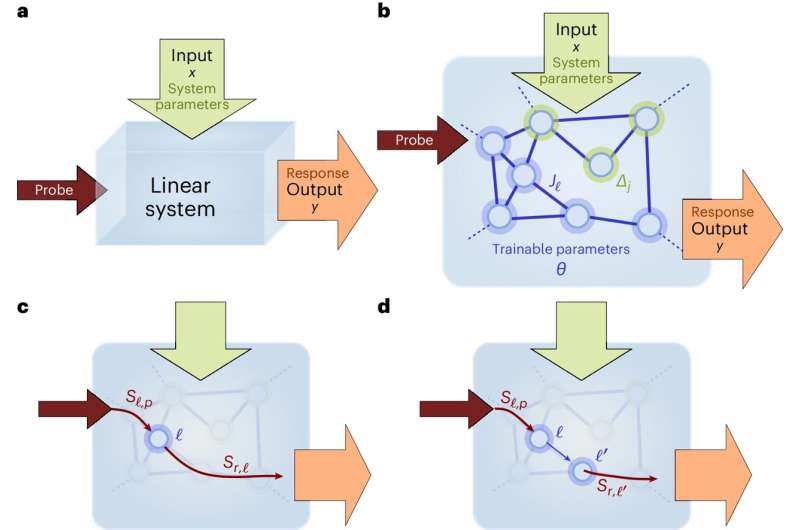
Fully nonlinear neuromorphic system with linear wave propagation. Credit: Nature Physics (2024). DOI: 10.1038/s41567-024-02534-9

Both challenges can be overcome with the new method proposed by Clara Wanjura and Florian Marquardt from the Max Planck Institute for the Science of Light in their new article in Nature Physics. "Normally, the data input is imprinted on the light field. However, in our new methods we propose to imprint the input by changing the light transmission," explains Marquardt, Director at the Institute.


In this way, the input signal can be processed in an arbitrary fashion. This is true even though the light field itself behaves in the simplest way possible in which waves interfere without otherwise influencing each other. Therefore, their approach allows one to avoid complicated physical interactions to realize the required mathematical functions which would otherwise require high-power light fields.

Evaluating and training this physical neural network would then become very straightforward. "It would really be as simple as sending light through the system and observing the transmitted light. This lets us evaluate the output of the network. At the same time, this allows one to measure all relevant information for the training," says Wanjura, the first author of the study.

The authors demonstrated in simulations that their approach can be used to perform image classification tasks with the same accuracy as digital neural networks.

In the future, the authors are planning to collaborate with experimental groups to explore the implementation of their method. Since their proposal significantly relaxes the experimental requirements, it can be applied to many physically very different systems. This opens up new possibilities for neuromorphic devices, allowing physical training over a broad range of platforms.


Website: International Research Awards on Computer Vision #computervision #deeplearning #machinelearning #artificialintelligence #neuralnetworks,  #imageprocessing #objectdetection #imagerecognition #faceRecognition #augmentedreality #robotics #techtrends #3Dvision #professor #doctor #institute #sciencefather #researchawards #machinevision #visiontechnology #smartvision #patternrecognition #imageanalysis #semanticsegmentation #visualcomputing #datascience #techinnovation #university #lecture #biomedical

Visit Our Website : computer.scifat.com Nomination Link : x-i.me/sainom Registration Link : x-i.me/ishreg member Link : x-i.me/8Fvz Awards-Winners : x-i.me/compwin Testimonial : x-i.me/testim Contact us : computer@scifat.com

Get Connected Here:
==================


Friday, July 26, 2024

Emerging Trends in Generative AI


Generative AI, a subset of artificial intelligence, is redefining the technological landscape with its ability to generate new content, designs, and ideas.

By leveraging sophisticated algorithms, generative AI creates outputs that mimic human creativity, spanning various fields such as art, music, design, and writing. As this technology matures, several key trends are shaping its trajectory, offering insights into its future potential and applications.

This article explores these emerging trends in Generative AI, emphasizing the development of innovative products, strategic collaborations, integration across industry verticals, the rise of virtual modes in the metaverse, and ongoing technological advancements.


1. Focus on Developing Innovative and Advanced Products

One of the most prominent emerging trends in Generative AI market is the focus on developing innovative and advanced products. Leading companies are channeling their efforts toward creating cutting-edge solutions to meet specific demands and maintain their competitive edge.

For instance, in April 2023, Ai Palette, a Singapore-based startup, launched Concept Genie, a generative AI tool designed for FMCG product innovation. Concept Genie leverages AI to generate new product concepts, bridging the gap between idea generation and evaluation.

It offers a comprehensive end-to-end solution for product innovation, integrating various aspects of the workflow from opportunity identification to concept generation and screening. This seamless combination of processes enables rapid innovation, significantly reducing the time required to bring new products to market.


2. Strategic Collaboration for the Adoption of Generative AI Tools in Businesses

Strategic collaboration and partnerships are becoming increasingly popular as businesses seek to harness the full potential of generative AI. By joining forces, companies can pool their resources and expertise to overcome barriers such as cost, scale, and trust, facilitating the widespread adoption of generative AI technologies.

In January 2024, Capgemini SE, a France-based IT and consulting firm, entered into a multi-year strategic collaboration with Amazon Web Services (AWS). This partnership aims to promote the adoption of generative AI solutions across organizations of all sizes.

By leveraging Capgemini's AWS Centers of Excellence, the collaboration seeks to transition clients from isolated pilot projects to large-scale deployments, thereby unlocking significant business benefits.

Similarly, in May 2023, Tata Consultancy Services (TCS) expanded its partnership with Google Cloud to launch TCS Generative AI. This initiative utilizes Google Cloud's generative AI services to develop customized business solutions, enabling clients to accelerate growth and transformation through cutting-edge technology.


3. Integration of Generative AI Across Industry Verticals

The integration of generative AI across various industry verticals is another key emerging trends in Generative AI driving its adoption. By embedding generative AI into diverse sectors, companies can enhance their operations, create personalized experiences, and unlock new revenue streams.

In December 2023, Mastercard introduced "Shopping Muse," an innovative artificial intelligence shopping app designed to transform the retail digital catalog shopping experience.

Shopping Muse uses generative AI to analyze user behavior, context, and preferences, providing personalized purchase recommendations. This integration of AI enhances the overall shopping experience by delivering tailored suggestions that align with individual consumer needs.


4. Rise in Virtual Mode in the Metaverse

The rise of virtual modes in the metaverse is a significant trend that has gained traction in recent years. The metaverse, a collective virtual shared space, is becoming a fertile ground for generative AI applications, particularly in augmented reality (AR) and 3D presentations.

In November 2023, JigSpace, a leading 3D presentation platform, launched Spark, an innovative tool that uses generative AI to create optimal 3D product presentations in AR.

Spark simplifies the creation of effective presentations, enabling users to communicate and share knowledge in 3D and AR with ease. This tool democratizes AR, making it accessible to a broader audience and enhancing efficiency by reducing the time required to produce high-quality presentations.


5. Technological Advancement

The generative AI market is set for significant growth, driven by continuous technological advancements. Major industry players like Nvidia are at the forefront of these developments, pushing the boundaries of what generative AI can achieve.

In March 2023, Shutterstock, Inc. unveiled another critical association with Nvidia to transform the 3D material production.

This synergy harnesses Picasso which is Nvidia’s generative AI cloud services in converting textual descriptions into accurate 3D objects. This new approach cuts down creation time significantly from hours to minutes; thus, it is an example of sophisticated generative AI technologies’ power in terms of enhancing creativity’s efficiency.


Conclusion

Emerging trends in Generative AI reveal promising developments in terms of innovation, industry collaborations, and applications to various sectors. The efforts directed towards the creation of highly sophisticated end-products along with the formulation of cooperation strategies help implement generative AI systems in small, mid, and large enterprises.

The adoption of AI in various sectors and the development of virtual ways in the metaverse universe are broadening the possibilities of the GA use cases to improve the customers’ experience.

Realizing new possibilities and reshaping the digital space, constant developments in technology, initiated by market players, influence the generative AI market’s progress. In this vein, generative AI will become increasingly central to defining the contours of the world’s technological, creative, and innovative prospects.


Website: International Research Awards on Computer Vision #computervision #deeplearning #machinelearning #artificialintelligence #neuralnetworks,  #imageprocessing #objectdetection #imagerecognition #faceRecognition #augmentedreality #robotics #techtrends #3Dvision #professor #doctor #institute #sciencefather #researchawards #machinevision #visiontechnology #smartvision #patternrecognition #imageanalysis #semanticsegmentation #visualcomputing #datascience #techinnovation #university #lecture #biomedical

Visit Our Website : computer.scifat.com Nomination Link : x-i.me/sainom Registration Link : x-i.me/ishreg member Link : x-i.me/8Fvz Awards-Winners : x-i.me/compwin Testimonial : x-i.me/testim Contact us : computer@scifat.com

Get Connected Here:
==================

Thursday, July 25, 2024

The Role of AI and Machine Learning in Battery Optimization


The rise of electric vehicles (EVs), renewable energy storage systems, and portable electronics has placed unprecedented demand on battery technology. Optimizing battery performance, longevity, and efficiency has become critical to meeting these demands. Artificial Intelligence (AI) and Machine Learning (ML) are proving to be powerful tools in this quest, driving significant advancements in battery technology.


Understanding Battery Optimization

Battery optimization encompasses several objectives: enhancing energy density, prolonging lifespan, improving safety, and reducing charging times. Achieving these goals requires a deep understanding of the complex chemical and physical processes within batteries, which can be challenging using traditional methods alone. This is where AI and ML come into play, offering sophisticated tools for analyzing vast amounts of data and making precise predictions.


Predictive Maintenance and Health Monitoring

One of the most impactful applications of AI in battery technology is predictive maintenance and health monitoring. AI algorithms can analyze data from sensors embedded in battery packs to predict potential failures and estimate remaining useful life. By continuously monitoring parameters such as temperature, voltage, and current, AI can detect anomalies and degradation patterns early, allowing for timely maintenance and preventing catastrophic failures.


Machine learning
models, particularly those based on time-series analysis, can predict battery aging and degradation with high accuracy. These predictions enable proactive interventions, such as adjusting charging protocols or replacing cells, to extend battery lifespan and ensure optimal performance.


Enhancing Battery Management Systems (BMS)

Battery Management Systems (BMS) are critical for ensuring the safe and efficient operation of battery packs. AI and ML enhance BMS capabilities by providing more accurate state-of-charge (SoC) and state-of-health (SoH) estimations. Traditional BMS rely on pre-defined algorithms and models, which may not adapt well to varying conditions and aging batteries. In contrast, AI-driven BMS can learn from real-time data, continuously improving their accuracy and adaptability.

For example, machine learning models can dynamically adjust charging and discharging cycles to minimize wear and tear on the battery, thereby extending its lifespan. AI can also optimize thermal management, preventing overheating and improving safety.


Accelerating Battery Design and Development

The design and development of new battery chemistries and configurations are time-consuming and resource-intensive processes. AI and ML can significantly accelerate this process by analyzing historical data and predicting the performance of new materials and designs. Machine learning models can identify promising candidates for battery electrodes, electrolytes, and other components, reducing the need for extensive trial-and-error experimentation.

Generative models, such as neural networks, can simulate thousands of potential battery designs, predicting their performance characteristics based on learned patterns. This approach allows researchers to focus on the most promising options, speeding up the development of next-generation batteries with higher energy densities and improved safety.


Optimizing Charging Strategies

Charging strategies have a profound impact on battery lifespan and performance. Fast charging, while convenient, can accelerate degradation if not managed properly. AI-driven charging algorithms can optimize the charging process by balancing speed and longevity. For instance, machine learning models can determine the optimal charging current and voltage based on the battery’s condition and environmental factors, minimizing stress on the battery.

Adaptive charging strategies, powered by AI, can adjust in real-time to changes in battery health and usage patterns. This ensures that batteries are charged efficiently and safely, maximizing their useful life and reducing the risk of overcharging or overheating.


Enabling Smart Grids and Energy Storage

AI and ML are also crucial in integrating batteries into smart grids and energy storage systems. By predicting energy demand and supply patterns, AI can optimize the use of batteries for load balancing and peak shaving. Machine learning algorithms can forecast renewable energy generation from sources like solar and wind, enabling more efficient storage and distribution of energy.

In smart grid applications, AI can coordinate the charging and discharging of distributed battery systems, ensuring that energy is stored when supply exceeds demand and released when demand is high. This not only enhances grid stability but also maximizes the economic value of energy storage systems.


The Future of AI in Battery Optimization

The future of battery optimization lies in the continued advancement of AI and ML technologies. As more data becomes available from battery usage and performance, AI models will become increasingly accurate and predictive. The integration of AI with Internet of Things (IoT) devices and edge computing will enable real-time, decentralized battery management and optimization.

Moreover, AI-driven research is likely to unlock new materials and chemistries that were previously considered impractical. By simulating and optimizing complex chemical interactions, AI can pave the way for breakthroughs in energy storage technology, such as solid-state batteries and beyond-lithium chemistries.


Conclusion

AI and machine learning are transforming the landscape of battery technology. From predictive maintenance and health monitoring to accelerating design and optimizing charging strategies, AI-driven solutions are enhancing the performance, safety, and longevity of batteries. As these technologies continue to evolve, they will play an increasingly vital role in meeting the growing demand for efficient and reliable energy storage.


Website: International Research Awards on Computer Vision #computervision #deeplearning #machinelearning #artificialintelligence #neuralnetworks,  #imageprocessing #objectdetection #imagerecognition #faceRecognition #augmentedreality #robotics #techtrends #3Dvision #professor #doctor #institute #sciencefather #researchawards #machinevision #visiontechnology #smartvision #patternrecognition #imageanalysis #semanticsegmentation #visualcomputing #datascience #techinnovation #university #lecture #biomedical

Visit Our Website : computer.scifat.com Nomination Link : x-i.me/sainom Registration Link : x-i.me/ishreg member Link : x-i.me/8Fvz Awards-Winners : x-i.me/compwin Testimonial : x-i.me/testim Contact us : computer@scifat.com

Get Connected Here:
==================

Wednesday, July 24, 2024

The future of healthcare: Why enterprises must embrace AI innovation


The intersection of AI, software, and data management is set to revolutionize healthcare and will serve as a critical driver of medical innovation and improved patient outcomes. But successfully adopting this mix of emerging and advanced technologies can be daunting and complex. As healthcare leaders consider how to best embrace AI innovation, there are several steps to take that will ensure their organizations are positioned to address today’s most pressing challenges and pave the way to a healthier future.


The pivotal role of AI in healthcare

From clinical applications to operational efficiencies, AI is already having a significant impact on the healthcare industry. Radiology, for instance, stands out as a pioneering field where AI is making significant strides. Advanced diagnostic procedures such as MRIs, CAT scans, and X-rays are now benefiting from AI’s ability to assist radiologists by highlighting potential issues that may be overlooked during manual reviews. This not only scales human effort but also enhances diagnostic accuracy, enabling radiologists to focus on more complex cases and significantly reducing the risk of oversight.

These applications also extend into drug research. By analyzing vast datasets, AI can identify new chemical combinations and potential treatments for diseases like ALS and Alzheimer’s. This capability accelerates the discovery process and opens new avenues for medical research that were previously unimaginable.

Beyond improved patient outcomes, AI integrated into site reliability engineering can help improve the scalability of software systems. By analyzing problem reports and test failures, AI can identify patterns and underlying issues that human operators might miss. This improves system reliability and ensures that healthcare infrastructure remains robust and efficient.

At the other end of the spectrum, AI is also deeply influencing more traditional operational and regulatory elements of healthcare. In revenue management, for example, AI is streamlining processes like prior authorizations. Traditionally, these tasks involved significant manual effort and were prone to errors. AI systems can now automate much of this work, reducing paperwork errors and allowing healthcare professionals to focus more on patient care.

Although AI is primarily seen as an assistive technology, ensuring that it is used ethically and safely is paramount. Enterprises should use ethical frameworks to ensure that AI applications undergo rigorous testing and validation before being deployed in order to safeguard patient safety and data privacy.

How to embrace the digital health revolution

The integration of AI into healthcare is a revolution that promises to transform every facet of the industry. With the right frameworks in place, healthcare providers can not only improve patient outcomes but also ensure that the industry remains resilient and adaptive to future challenges.

First, it will be key to identify clear objectives for AI’s adoption. Determine specific areas where AI can add value, such as diagnostics, predictive analytics, patient management, drug discovery, and operational efficiencies. Leaders should also set measurable goals for what the AI implementation aims to achieve to better understand its outcomes.

Choosing the right AI technologies and platforms – specifically, those that are tailored to the healthcare industry – will also be an important fundamental step. Enterprises should look for tools and applications that comply with all relevant healthcare regulations and standards, such as HIPAA in the United States, and ensure that the AI tools integrate seamlessly into existing clinical workflows to avoid disruption. This includes interoperability with Electronic Health Records and other healthcare systems.

Once the right platforms and solutions are in place, start with pilot projects to test AI applications on a smaller scale. This allows for the identification and resolution of potential issues before a full-scale rollout, and feedback from these projects will help refine and improve future models. In parallel, teams should ensure regular monitoring and performance evaluations are happening to track progress against the implementation’s objectives and metrics such as accuracy, efficiency, and patient outcomes. From there, all that’s left to do is scale these applications up across the organization for greater efficiency and patient benefits.


Website: International Research Awards on Computer Vision #computervision #deeplearning #machinelearning #artificialintelligence #neuralnetworks,  #imageprocessing #objectdetection #imagerecognition #faceRecognition #augmentedreality #robotics #techtrends #3Dvision #professor #doctor #institute #sciencefather #researchawards #machinevision #visiontechnology #smartvision #patternrecognition #imageanalysis #semanticsegmentation #visualcomputing #datascience #techinnovation #university #lecture #biomedical

Visit Our Website : computer.scifat.com Nomination Link : x-i.me/sainom Registration Link : x-i.me/ishreg member Link : x-i.me/8Fvz Awards-Winners : x-i.me/compwin Testimonial : x-i.me/testim Contact us : computer@scifat.com

Get Connected Here:
==================

Rise of AI-Driven Careers: Opportunities and Challenges


AI has brought drastic changes to the contemporary work environment and business world, as well as coining new occupations that earlier were reflected in fantastic movies and books. Thus, the development of AI brings more and more influence on people’s working lives, and at the same time, opens a new wide range of opportunities and generates lots of issues. The topic of this article reads AI-driven careers, what careers are being impacted, what skills are required, and what challenges might be seen by individuals in those professions.


AI’s place is not strictly defined; instead, it is present across various industries and has left its imprint on their processes. Automation is one of the significant facets of this change whereby various activities are efficiently accomplished by Accuse Intelligence Systems if they are recurrent and mundane. This not only increases productivity but also allows people to pay more attention to the higher-value tasks in their jobs.

The Rise of AI-Driven Careers


It is most apparent in industries where analysis of data and identifying patterns are germane. In the area of health care, for example, AI algorithms are capable of scanning large volumes of data to look for tendencies and patterns that would be useful in diagnosing patients’ conditions or in developing their treatment regimens. Banking and finance are areas where the usage of AI can positively hit efficiency, by providing fast calculations for risk and investment analytics.

The usage of AI-based robotics has revolutionized manufacturing by automating processes and improving the efficiency and accuracy of the operation. Today in Information technology and software development, Artificial Intelligence serves as an important commodity that ranges from simple coding assistance, and error detection to the generation of innovative solutions.


This increase in the use of AI is not about substitution or automating tasks, it’s also about amplification. AI continues to be an addition to human capacities, wherein it provides information, advice, and assistance in making decisions. Such a situation where human workers combine efforts with AI technologies is quite different from the past narrative of technology taking over jobs, which suggests that people integrate and improve on technologies as they provide better solutions to problems. Let us cover in-depth about the potential of AI in different sectors.

AI in Specific Industries

Healthcare


They have established themselves as a strong tool leveraged in diagnosis, treatment, and patient care in the sphere of healthcare AI use cases. Massive data sets can be processed using multiple algorithms in the case of the machine learning approach which enables analysts to come up with some patterns that would have been hard to observe. This not only saves a lot of time involved in the process of diagnosis but also aids in designing individual patient care plans. Artificial Intelligence is also advancing in the medical field through the use of robotics in performing surgeries; the robots improve the level of accuracy in operations.

Finance


The financial sector has been revolutionized particularly through the application of Artificial Intelligence. Big Data processing by automated systems acquires tremendous volumes of data at high rates and helps refine AI in risk assessment and investment plans. AI is now employed in most firms and businesses to deal with customers through chatbots for immediate responses to their operations when it comes to financial services. The elements that analyze and come up with predictive models for the use of AI use cases in finance are also equally relevant in AI for fraud detection and cybersecurity.

Manufacturing


Robotic technology has emerged as one of the most transformative technologies in manufacturing today with the advanced use of AI. Production automation is one of the key multiplier firms that not only increases production rates but also minimizes mistakes and wastage. Through the help of artificial intelligence, predictive maintenance is applied, so that equipment and machinery are serviced before a problem arises. This use of AI in production is not the aspect of removing workers but enhancing their function and consequently improving the efficiency of production.

Information Technology and Software Development


Now in the sphere of IT and software development, AI is a notable part of creative processes. AI is helpful in the coding process, in defining bugs as well as in coming up with excellent ideas and solutions. Due to the analysis of the user’s behavior, there can be defined new opportunities for the creation of actual applications for users. Working together, human imagination and artificial intelligence are progressing innovation within the tech sector.

However, it is equally important to understand the problems and implications of AI implementation in those sectors mentioned above. The issue of potential biases in algorithms and the need to exercise caution in relating people’s data to subsequent outcomes means that there must be strong measures put in place to ensure that the positive impacts of AI in different industries are properly realized.

Opportunities in AI-Driven Careers

1. Expanding Job Markets


New professions have emerged over time because of the existence of AI. Such professions as data scientist, artificial intelligence engineer, machine learning specialist, and robotics engineer are sought-after. All fields of industries nowadays, including the pharmaceutical, banking, and finance industries, are looking for talents to design and integrate technologies that will maximize productivity in their organizations. The World Economic Forum shows that while AI and automation are expected to result in the loss of 75 million jobs by 2025, it will generate 58 million new jobs as well.

2. Transforming Traditional Roles


AI is not only coming up with new jobs that did not exist before but also is reshaping jobs that we have always known. For example, in marketing AI tools are applied in aspects such as analytics, segments, and advertising. In finance, they do things such as running portfolios, identifying fraud, and trade automation. Such incorporation of AI as part of functions was seen as needing workers to reskill and embrace new technology.

3. Enhanced Productivity and Efficiency


AI optimizes the work process through the automation of reviewing and increasing the effectiveness of the time spent by specialists on important activities. In production, artificial intelligence controls robots and they do their tasks perfectly and efficiently. In customer relations, the AI chatbots respond to frequently asked questions while transferring complex cases to human personnel. This shift is a win-win; it increases efficiency and at the same time, offers the executives a chance to engage in more meaningful work.

4. Innovation and Creativity


AI-driven professions promote inventions and creativity. Other than that, AI can study large volumes of data to help outline trends and patterns in the market, which can then help in the creation of prototypes of new products and services. AI art, music, and writing are now possible in creative industries and new possibilities of art are being established. In these fields, professionals are using AI to the limits of the unknown to create newer and better works.

The Skills Necessary for AI Jobs

1. Technical Proficiency


Technical skills are important in artificial intelligence professions. This entails familiarization with coding languages, for example, Python, R, and Java, and machine learning platforms for instance Tensor flow and PyTorch. Knowledge in algorithms and statistics as well as data structure forms the key foundation for AI solutions development.

2. Data Literacy


Deep learning, one of the most common approaches in evolving artificial intelligence, principally thrives on data. This implies that modern professionals need to be familiar with the processes used for data gathering, preparation, and recall. Data analysis and reporting are also another because such skills help a professional to draw maximum actionable value from sets of complicated data. Knowledge of big data technologies and tools like Hadoop and Spark become more essential.

3. Domain Knowledge


Domain knowledge improves the performance of applications developed by artificial intelligence. For instance, in medicine, knowledge of medical terms and analyzing the processes of patient treatment will be indispensable in creating AI solutions for diagnostics. Likewise in finance expertise in markets and the rules that govern them is crucial when developing AI solutions for trading and mitigating risks.

4. Soft Skills


Soft skills are as crucial for AI-based professions. Analytical skills and problem-solving skills they employ let professionals work on various problems. However, one has to embark on understanding communication strategies when it comes to AI to people especially those who do not have a technical background. Some of the core competencies include working in a team since most projects require the pooling of effort from various disciplines.

Challenges in AI-Driven Careers

1. Ethical and Bias Concerns


Another big problem for AI-Driven careers is the ethical and bias issues that have to be solved. AI systems can create unfair situations since they provide results aligned with bias found in the training data. In this case, with AI models being used, professionals must make sure that the models are clear, do not favor any party, and are answerable. This entails the proper assessment and testing methods shall be followed, as well as following the proper ethical standards.

2. Job Displacement


As we witnessed, AI offers new types of jobs, but the prospect of job automatization is always with us. Automation of the procedural and day-to-day tasks means that some positions will become irrelevant shortly. For example, AI-driven robots can do the work that human beings do in industries such as manufacturing by assembling cars. Employees in the mentioned occupations have to be ready for retraining and changing their occupations. Such consequences therefore require governments and organizations to embark on investment in the development and training of the workforce.

3. Security and Privacy Issues


AI systems process users’ information that, in most cases, is considered to be personal, thereby creating security and privacy issues. Negative outcomes that can occur depending on attacks on AI systems may include consequences like data breaches or manipulation of the AI models. Medical workers have to become more attentive to such matters as cybersecurity and following the guidelines for protecting data. To protect AI systems, organizations should employ stringent and efficient encryption and access control and conduct security assessments frequently.

4. Continuous Learning and Adaptation


Learning is the key to AI-Driven careers. It is widely noted that the subject of AI is rather dynamic, and it is evolving at a fairly fast rate, which means that people cannot remain unaffected by the changes and have to learn as they go. That is why, professionals need to be always informed about the current progress in AI research and developments. This calls for continuing education, enrolling in workshops, conferences, and courses for higher learning or specialized certifications. The fact is that the AI careers are rather volatile and persons in these career fields should be ready for changes all the time.


Conclusion

It can be seen that new careers are emerging due to the use of AI offer many opportunities and problems. This is mainly due to the growth of the job markets, the evolution of conventional roles, paperwork increases and optimization, and the possibilities to develop new products and services resulting in the demand for AI specialists. However, ethical issues, the threat of job loss, security concerns, and training needs are known to be some of the challenges associated with the self-directed learning environment.

Managing through this environment entails sound technical skills blended with ethical practices, substantive domain expertise alongside computational proficiency and data literacy, and personal continuing education.

If AI is to be used to its full potential and the negatives of it effectively mitigated, the workforce must be prepared. With the right mindset towards AI-driven careers that encourage the practice of distinct approaches and different attitudes toward AI, endurance is guaranteed in the unpredictable world that is characterized by exponential AI growth. It can be without any doubt said that AI is the future of work and individuals who leverage the possibilities of its application will be among the pioneers of innovative development.


Website: International Research Awards on Computer Vision #computervision #deeplearning #machinelearning #artificialintelligence #neuralnetworks,  #imageprocessing #objectdetection #imagerecognition #faceRecognition #augmentedreality #robotics #techtrends #3Dvision #professor #doctor #institute #sciencefather #researchawards #machinevision #visiontechnology #smartvision #patternrecognition #imageanalysis #semanticsegmentation #visualcomputing #datascience #techinnovation #university #lecture 

Visit Our Website : computer.scifat.com Nomination Link : x-i.me/sainom Registration Link : x-i.me/ishreg member Link : x-i.me/8Fvz Awards-Winners : x-i.me/compwin Testimonial : x-i.me/testim Contact us : computer@scifat.com

Get Connected Here:
==================

Monday, July 22, 2024

How AI and Machine Learning Are Transforming Threat Detection


In today’s digital age, cybersecurity is a critical concern for businesses and individuals alike. As cyber threats grow increasingly sophisticated, traditional methods of threat detection and prevention are no longer sufficient.

To stay ahead of cybercriminals, the cybersecurity industry is turning to artificial intelligence (AI) and machine learning (ML) technologies. These advanced tools are revolutionizing threat detection, making it more accurate, efficient, and proactive. This article explores how AI and ML are transforming cybersecurity and shaping the future of threat detection.


The Role of AI and Machine Learning in Cybersecurity

Understanding AI and Machine Learning

AI refers to the simulation of human intelligence processes by machines, particularly computer systems.

Machine learning, a subset of AI, involves the use of algorithms and statistical models that enable computers to learn from and make predictions based on data. In the context of cybersecurity, AI and ML can analyze vast amounts of data at unprecedented speeds, identifying patterns and anomalies that may indicate potential threats.

Application in Cybersecurity

AI and ML are being increasingly applied to various aspects of cybersecurity, including:Threat Detection: Identifying malicious activities, such as malware, Phishing attempts, and network intrusions.
Behavioral Analysis: Monitoring user behavior to detect anomalies that could indicate a security breach.
Automated Response: Responding to threats in real-time without human intervention.
Risk Assessment: Evaluating potential vulnerabilities within a system to prioritize security efforts.
Benefits of AI and Machine Learning in Threat Detection

Improved Accuracy and Speed

AI and ML technologies enhance the accuracy and speed of threat detection. Traditional security systems rely on predefined rules and signatures to identify threats, which can be limited and slow. In contrast, AI-powered systems continuously learn from new data, adapting to evolving threats and reducing the time taken to detect malicious activities.

Reduction of False Positives and False Negatives

False positives (benign activities incorrectly identified as threats) and false negatives (actual threats that go undetected) are significant challenges in cybersecurity. AI and ML algorithms can analyze complex datasets more accurately, significantly reducing the rate of false positives and false negatives. This ensures that security teams can focus on genuine threats without being overwhelmed by false alarms.

Proactive Threat Hunting and Anomaly Detection

AI and ML enable proactive threat hunting by continuously analyzing network traffic, user behavior, and system logs to identify potential threats before they cause harm. These technologies can detect anomalies that might indicate an impending attack, allowing security teams to take preventative measures. This proactive approach is crucial in mitigating the impact of cyber threats.
Real-World Applications and Case Studies

Successful Implementations

Several companies have successfully implemented AI-driven cybersecurity solutions. For example, Darktrace uses AI to provide autonomous response capabilities, detecting and responding to threats in real-time. Another company, Cylance, leverages machine learning to predict and prevent cyberattacks, even those involving zero-day vulnerabilities.
Challenges and Considerations

Potential Drawbacks and Limitations

Despite the benefits, AI and ML in cybersecurity are not without challenges. One potential drawback is the risk of adversarial attacks, where cybercriminals manipulate AI algorithms to bypass security measures. Additionally, the complexity of AI systems can make them difficult to understand and manage.

Ethical Considerations and Privacy Concerns

The use of AI in cybersecurity raises ethical and privacy concerns. The continuous monitoring of user behavior and network traffic can infringe on privacy if not properly managed. It is essential to balance security needs with privacy rights, ensuring that AI systems are transparent and compliant with regulations.

Importance of Human Oversight and Expertise

While AI and ML can automate many aspects of threat detection, human oversight remains crucial. Security experts are needed to interpret AI findings, make strategic decisions, and handle complex threats that require a human touch. Combining AI capabilities with human expertise creates a more robust cybersecurity defense.
The Future Outlook

Predictions for the Next Decade

The future of AI-driven cybersecurity looks promising. In the next decade, we can expect AI and ML technologies to become even more sophisticated, with enhanced capabilities for detecting and responding to advanced threats. Predictive analytics will play a larger role, allowing organizations to anticipate and mitigate risks before they materialize.

Emerging Trends and Technologies

Several emerging trends and technologies are set to shape the future of AI in cybersecurity:Explainable AI (XAI): Ensuring that AI decisions are transparent and understandable to humans.
Federated Learning: Enabling AI models to learn from decentralized data sources without compromising privacy.
Quantum Computing: While still in its infancy, quantum computing could revolutionize AI capabilities and pose new challenges for cybersecurity.


Conclusion

AI and machine learning are transforming the landscape of cybersecurity, offering improved accuracy, speed, and proactive threat detection capabilities. As cyber threats continue to evolve, these advanced technologies will be essential in protecting businesses and individuals from malicious activities. However, it is crucial to address the challenges and ethical considerations associated with AI and ensure that human expertise remains an integral part of the cybersecurity ecosystem. By staying ahead of the curve and embracing AI-driven solutions, organizations can strengthen their defenses and secure their digital future.

For businesses looking to enhance their cybersecurity posture, exploring AI and machine learning solutions is a strategic imperative. Start by evaluating your current security measures and identifying areas where AI can make a significant impact. Leverage the wealth of resources available, including case studies and expert insights, to implement AI-driven cybersecurity solutions effectively. By doing so, you can stay ahead of cyber threats and protect your organization in an increasingly digital world.


Website: International Research Awards on Computer Vision #computervision #deeplearning #machinelearning #artificialintelligence #neuralnetworks,  #imageprocessing #objectdetection #imagerecognition #faceRecognition #augmentedreality #robotics #techtrends #3Dvision #professor #doctor #institute #sciencefather #researchawards #machinevision #visiontechnology #smartvision #patternrecognition #imageanalysis #semanticsegmentation #visualcomputing #datascience #techinnovation #university #lecture 

Visit Our Website : computer.scifat.com Nomination Link : x-i.me/sainom Registration Link : x-i.me/ishreg member Link : x-i.me/8Fvz Awards-Winners : x-i.me/compwin Testimonial : x-i.me/testim Contact us : computer@scifat.com

Get Connected Here:
==================

Sunday, July 21, 2024

Reinforcement Learning AI Might Bring Humanoid Robots to Real World


Two recent papers in Science Robotics highlight how that type of AI — called reinforcement learning — could make such robots a reality.

“We’ve seen really wonderful progress in AI in the digital world with tools like GPT,” says Ilija Radosavovic, a computer scientist at the University of California, Berkeley. “But I think that AI in the physical world has the potential to be even more transformational.”

The state-of-the-art software that controls the movements of bipedal bots often uses what’s called model-based predictive control. It’s led to very sophisticated systems, such as the parkour-performing Atlas robot from Boston Dynamics. But these robot brains require a fair amount of human expertise to program, and they don’t adapt well to unfamiliar situations. Reinforcement learning, or RL, in which AI learns through trial and error to perform sequences of actions, may prove a better approach.

“We wanted to see how far we can push reinforcement learning in real robots,” says Tuomas Haarnoja, a computer scientist at Google DeepMind and coauthor of one of the Science Robotics papers. Haarnoja and colleagues chose to develop software for a 20-inch-tall toy robot called OP3, made by the company Robotis. The team not only wanted to teach OP3 to walk but also to play one-on-one soccer.

“Soccer is a nice environment to study general reinforcement learning,” says Guy Lever of Google DeepMind, a coauthor of the paper. It requires planning, agility, exploration, cooperation and competition.

The toy size of the robots “allowed us to iterate fast,” Haarnoja says, because larger robots are harder to operate and repair. And before deploying the machine learning software in the real robots — which can break when they fall over — the researchers trained it on virtual robots, a technique known as sim-to-real transfer.

Training of the virtual bots came in two stages. In the first stage, the team trained one AI using RL merely to get the virtual robot up from the ground, and another to score goals without falling over. As input, the AIs received data including the positions and movements of the robot’s joints and, from external cameras, the positions of everything else in the game. (In a recently posted preprint, the team created a version of the system that relies on the robot’s own vision.) The AIs had to output new joint positions. If they performed well, their internal parameters were updated to encourage more of the same behavior. In the second stage, the researchers trained an AI to imitate each of the first two AIs and to score against closely matched opponents (versions of itself).

To prepare the control software, called a controller, for the real-world robots, the researchers varied aspects of the simulation, including friction, sensor delays and body-mass distribution. They also rewarded the AI not just for scoring goals but also for other things, like minimizing knee torque to avoid injury.

Real robots tested with the RL control software walked nearly twice as fast, turned three times as quickly and took less than half the time to get up compared with robots using the scripted controller made by the manufacturer. But more advanced skills also emerged, like fluidly stringing together actions. “It was really nice to see more complex motor skills being learned by robots,” says Radosavovic, who was not a part of the research. And the controller learned not just single moves, but also the planning required to play the game, like knowing to stand in the way of an opponent’s shot.

“In my eyes, the soccer paper is amazing,” says Joonho Lee, a roboticist at ETH Zurich. “We’ve never seen such resilience from humanoids.”

But what about human-sized humanoids? In the other recent paper, Radosavovic worked with colleagues to train a controller for a larger humanoid robot. This one, Digit from Agility Robotics, stands about five feet tall and has knees that bend backward like an ostrich. The team’s approach was similar to Google DeepMind’s. Both teams used computer brains known as neural networks, but Radosavovic used a specialized type called a transformer, the kind common in large language models like those powering ChatGPT.

Instead of taking in words and outputting more words, the model took in 16 observation-action pairs — what the robot had sensed and done for the previous 16 snapshots of time, covering roughly a third of a second — and output its next action. To make learning easier, it first learned based on observations of its actual joint positions and velocity, before using observations with added noise, a more realistic task. To further enable sim-to-real transfer, the researchers slightly randomized aspects of the virtual robot’s body and created a variety of virtual terrain, including slopes, trip-inducing cables and bubble wrap.

After training in the digital world, the controller operated a real robot for a full week of tests outside — preventing the robot from falling over even a single time. And in the lab, the robot resisted external forces like having an inflatable exercise ball thrown at it. The controller also outperformed the non-machine-learning controller from the manufacturer, easily traversing an array of planks on the ground. And whereas the default controller got stuck attempting to climb a step, the RL one managed to figure it out, even though it hadn’t seen steps during training.

Reinforcement learning for four-legged locomotion has become popular in the last few years, and these studies show the same techniques now working for two-legged robots. “These papers are either at-par or have pushed beyond manually defined controllers — a tipping point,” says Pulkit Agrawal, a computer scientist at MIT. “With the power of data, it will be possible to unlock many more capabilities in a relatively short period of time.”

And the papers’ approaches are likely complementary. Future AI robots may need the robustness of Berkeley’s system and the dexterity of Google DeepMind’s. Real-world soccer incorporates both. According to Lever, soccer “has been a grand challenge for robotics and AI for quite some time.”


Website: International Research Awards on Computer Vision #computervision #deeplearning #machinelearning #artificialintelligence #neuralnetworks,  #imageprocessing #objectdetection #imagerecognition #faceRecognition #augmentedreality #robotics #techtrends #3Dvision #professor #doctor #institute #sciencefather #researchawards #machinevision #visiontechnology #smartvision #patternrecognition #imageanalysis #semanticsegmentation #visualcomputing #datascience #techinnovation #university #lecture 

Visit Our Website : computer.scifat.com Nomination Link : x-i.me/sainom Registration Link : x-i.me/ishreg member Link : x-i.me/8Fvz Awards-Winners : x-i.me/compwin Testimonial : x-i.me/testim Contact us : computer@scifat.com

Get Connected Here:
==================